THE BOOK
Some of the ideas discussed in this blog are published in my new book called "The Stonehenge Bluestones" -- available by post and through good bookshops everywhere. Bad bookshops might not have it....
To order, click
HERE

Tuesday, 3 September 2019

When does a delusion turn into a hoax?


I learned the other day that a certain well-known archaeologist was upset by my use of the words "hoax", "fantasist" and "conspirators."  Well, I found that very upsetting because I am a delicate flower and because I only ever use a word if it is exactly right, as befits somebody with a scientific background.

Let's just concentrate on the word "hoax" for the moment.  Yes, I have used the word quite often with regard to the attempts by Prof MPP and his colleagues (shall we call them fellow-conspirators?) to convince the world that they have found two Neolithic bluestone quarries and a "proto-Stonehenge" stone setting in West Wales.  As readers of this blog will know, we have examined the evidence presented in support of these contentions, and have found it wanting in every important respect.  It does not withstand scrutiny, and when this has been pointed out to the MPP team in journal articles  its response -- consistently -- is simply to ignore the points raised and to reiterate the story in ever more elaborate form, with or without the help of assorted journal editors and media journalists.

The radiocarbon dates, flagged up as supporting the quarrying hypothesis, actually falsify it.

So the research team members simply refuse to engage with others who question their evidence, their working methods and their conclusions.  Whatever you may think about bluestone quarries, you might agree with me that this is not a happy scenario, since both scientific practice and academic convention are consistently flouted.  It is not a good idea to simply ignore other senior scientists who have good reputations, simply because they do not agree with you.  Even if you are a firm believer in bluestone quarries and dismantled stone circles you might agree with me that it is never a good idea to refuse to accept scrutiny.  It simply does not look good.  If this happened in geomorphology, reputations would be terminally damaged.  But in archaeology, it appears that other rules apply.

So -- are the members of this research team just deluded, and swept along on a great wave of enthusiasm which makes it difficult for them to accept alternative interpretations of the things they are looking at?  They may indeed be deluded, but most deluded academics tend to be rather diffident and tend not to shout their delusions from the rooftops.  

This is different.  MPP and his team have built their story quite inexorably over the past eight years, never once engaging with the concerns that have been raised, never admitting to a dispute in the literature, and feeding quite assiduously more and more outrageous material to the media -- and obtaining acres of media coverage from gullible journalists.

You might agree with me that this goes far beyond delusion and humorous deception.  It is actually rather malicious.  In short, it is a typical academic hoax,  meeting all of the criteria itemised by
psychologist Peter Hancock.  He has has identified six steps which characterise a truly successful hoax:

Identify a constituency—a person or group of people who, for reasons such as piety or patriotism, or greed, will truly care about your creation.

Identify a particular dream which will make your hoax appeal to your constituency.

Create an appealing but "under-specified" hoax, with ambiguities

Have your creation discovered.

Find at least one champion who will actively support your hoax.

Make people care, either positively or negatively—the ambiguities encourage interest and debate

In another post, I have made very similar points:
https://brian-mountainman.blogspot.com/2019/08/the-bluestone-hoax-gets-ever-more.html

For a scientific hoax to be successful, it requires four preconditions:

1. A gullible public predisposed to believe in “new discoveries” — in this case, stories about the great skills of our prehistoric ancestors and the meaning of Stonehenge. In these days of alternative facts and false news, almost anything will grab the attention of the public. The mere use of the word "Stonehenge" in a press release guarantees wide media coverage.

2. A colourful and swashbuckling lead character who has a respectable past and a strong media presence. MPP is a popular figure who has been called the “Indiana Jones” of British archaeology, with a reputation for an endless stream of controversial theories.

3. A body of “evidence” cited in support of the hoax which cannot be checked or replicated by anybody else. As far as I am aware, there was no independent scrutiny or peer review of the dig sites at Rhosyfelin, Carn Goedog and Waun Mawn while MPP and his team were at work between 2011 and 2018. And the excavations have now been filled in, so that nobody can go back to them to check the cited “evidence”. Wonderful! That's a perfect scenario for a successful hoax……….

4. The ability to suppress or "drown out" anything inconvenient that might show up the hoax for what it is. This can be achieved by doing deals with big business or grant-giving bodies which see that there would be large negative impacts for them should the hoax be exposed. They will help you to promote the hoax and to suppress independent scientific research and conclusions. You can also "drown out" inconvenient expressions of concern by using your contacts to repeat the hoax in print as often as possible and to develop it bit by bit in a way that can be represented as "hypothesis confirmation." And of course you can vilify your opponents behind the scenes and use your establishment contacts to ensure that anything they write has little chance of being published. This is all very jolly as long as you are not concerned about scientific ethics.


As I pointed out, all four preconditions are amply fulfilled in this case. My own feeling is that the archaeologists were given a false sense of security and certainty by some seriously defective advice from the geologists Richard Bevins and Rob Ixer back in 2011, and that having initially celebrated the "quarry discovery" at Rhosyfelin with some rather unwise hyperbole,  they have found themselves dug in so deeply that they cannot get out without losing face.  So they plough on -- at very grave risk to their reputations -- in the hope that they will not get rumbled.  Too late, boys and girls........

For all good hoax hunters, this from Wikipedia might be entertaining:


A hoax is a falsehood deliberately fabricated to masquerade as the truth. It is distinguishable from errors in observation or judgment,[1] rumors, urban legends, pseudosciences, and April Fools' Day events that are passed along in good faith by believers or as jokes.

Elsewhere, a hoax is defined as "a humorous or malicious deception."


Definition

Robert Nares defined the word hoax as meaning "to cheat," dating from Thomas Ady's 1656 book A candle in the dark, or a treatise on the nature of witches and witchcraft.[8]

The term hoax is occasionally used in reference to urban legends and rumors, but the folklorist Jan Harold Brunvandargues that most of them lack evidence of deliberate creations of falsehood and are passed along in good faith by believers or as jokes, so the term should be used for only those with a probable conscious attempt to deceive.[2] As for the closely related terms practical joke and prank, Brunvand states that although there are instances where they overlap, hoax tends to indicate "relatively complex and large-scale fabrications" and includes deceptions that go beyond the merely playful and "cause material loss or harm to the victim."[9]

According to Professor Lynda Walsh of the University of Nevada, Reno, some hoaxes—such as the Great Stock Exchange Fraud of 1814, labeled as a hoax by contemporary commentators—are financial in nature, and successful hoaxers—such as P. T. Barnum, whose Fiji mermaid contributed to his wealth—often acquire monetary gain or fame through their fabrications, so the distinction between hoax and fraud is not necessarily clear.[10] Alex Boese, the creator of the Museum of Hoaxes, states that the only distinction between them is the reaction of the public, because a fraud can be classified as a hoax when its method of acquiring financial gain creates a broad public impact or captures the imagination of the masses.[11]

One of the earliest recorded media hoaxes is a fake almanac published by Jonathan Swift under the pseudonym of Isaac Bickerstaff in 1708.[12] Swift predicted the death of John Partridge, one of the leading astrologers in England at that time, in the almanac and later issued an elegy on the day Partridge was supposed to have died. Partridge's reputation was damaged as a result and his astrological almanac was not published for the next six years.[12]

It is possible to perpetrate a hoax by making only true statements using unfamiliar wording or context, such as in the Dihydrogen monoxide hoax. Political hoaxes are sometimes motivated by the desire to ridicule or besmirch opposing politicians or political institutions, often before elections.

A hoax differs from a magic trick or from fiction (books, movies, theatre, radio, television, etc.) in that the audience is unaware of being deceived, whereas in watching a magician perform an illusion the audience expects to be tricked.

A hoax is often intended as a practical joke or to cause embarrassment, or to provoke social or political change by raising people's awareness of something. It can also emerge from a marketing or advertising purpose. For example, to market a romantic comedy movie, a director staged a phony "incident" during a supposed wedding, which showed a bride and preacher getting knocked into a pool by a clumsy fall from a best man.[13] A resulting video clip of Chloe and Keith's Wedding was uploaded to YouTube and was viewed by over 30 million people and the couple was interviewed by numerous talk shows.[13] Viewers were deluded into thinking that it was an authentic clip of a real accident at a real wedding; but a story in USA Today in 2009 revealed it was a hoax.[13]

Governments sometimes spread false information to facilitate their objectives, such as going to war. These often come under the heading of black propaganda. There is often a mixture of outright hoax and suppression and management of information to give the desired impression.  In wartime and times of international tension rumors abound, some of which may be deliberate hoaxes. 

For example, this is a hoax:
A memorable and crowded meeting of the Geological Society was held in Burlington House, London, on December 18, to hear a paper read "On the Discovery of a Paleolithic Human Skull and Mandible in a Flint-bearing Gravel overlying the Wealden (Hastings Beds) at Piltdown, Fletching (Sussex),)" by Charles Dawson, F.S.A., F.G.S., and Arthur Smith Woodward, LL.D... Professor G. Elliot Smith was called on to give an account of his investigation on the cast of the cranial cavity, and he pointed out that, while the general shape and size of the brain was human, the arrangement of the meningeal arteries was typically simian, as was a deep notch in the occipital region; he regarded it as the most ape-like human brain of which we have any knowledge... There can be no doubt that this is a discovery of the greatest importance and will give rise to much discussion. It is the nearest approach we have yet reached to a "missing link," for whatever may be the final verdict as to the systemic position of Pithecanthropus erectus, probably few will deny that Eoanthropus Dawsoni is almost if not quite as much human as simian. The recent discoveries of human remains... are demonstrating that several races of man lived in paleolithic times, and we may confidently look forward to new finds which will throw fresh light upon the evolution of man. [3]

While this is the start of an article about a hoax:
The Piltdown Man was a paleoanthropological hoax in which bone fragments were presented as the fossilised remains of a previously unknown early human. These fragments consisted of parts of a skull and jawbone, said to have been collected in 1912 from a gravel pit at Piltdown, East Sussex, England. The Latin name Eoanthropus dawsoni ("Dawson's dawn-man", after the collector Charles Dawson) was given to the specimen. The significance of the specimen remained the subject of controversy until it was exposed in 1953 as a forgery, consisting of the lower jawbone of an orangutan deliberately combined with the cranium of a fully developed modern human. The Piltdown hoax is perhaps the most famous paleoanthropological hoax ever to have been perpetrated. It is prominent for two reasons: the attention paid to the issue of human evolution, and the length of time (more than 40 years) that elapsed from its discovery to its full exposure as a forgery.[4]

-------------------------------

Finally, the UCL press release from 7 December 2015.
Read it carefully.  It ticks all the boxes.

New research by the team published today in Antiquity presents detailed evidence of prehistoric quarrying in the Preseli hills in Pembrokeshire, helping to answer long-standing questions about why, when and how Stonehenge was built.

The team of scientists includes researchers from UCL, University of Manchester, Bournemouth University, University of Southampton, University of Leicester, Amgueddfa Cymru - National Museum Wales, and Dyfed Archaeological Trust.

The very large standing stones at Stonehenge are of 'sarsen', a local sandstone, but the smaller ones, known as 'bluestones', come from the Preseli hills in the Pembrokeshire Coast National Park. Geologists have known since the 1920s that the bluestones were brought to Stonehenge from somewhere in the Preseli Hills, but only now has there been collaboration with archaeologists to locate and excavate the actual quarries from which they came.

Director of the project, Professor Mike Parker Pearson (UCL Institute of Archaeology), said: "This has been a wonderful opportunity for geologists and archaeologists to work together. The geologists have been able to lead us to the actual outcrops where Stonehenge's stones were extracted."

The Stonehenge bluestones are of volcanic and igneous rocks, the most common of which are called dolerite and rhyolite. Dr Richard Bevins (Amgueddfa Cymru - National Museum Wales) and Dr Rob Ixer (UCL and University of Leicester) have identified the outcrop of Carn Goedog as the main source of Stonehenge's 'spotted dolerite' bluestones and the outcrop of Craig Rhos-y-felin as a source for one of the 'rhyolite' bluestones. The research published today details excavations at Craig Rhos-y-felin specifically.

The special formation of the rock, which forms natural pillars at these outcrops, allowed the prehistoric quarry-workers to detach each megalith (standing stone) with a minimum of effort. "They only had to insert wooden wedges into the cracks between the pillars and then let the Welsh rain do the rest by swelling the wood to ease each pillar off the rock face" said Dr Josh Pollard (University of Southampton). "The quarry-workers then lowered the thin pillars onto platforms of earth and stone, a sort of 'loading bay' from where the huge stones could be dragged away along trackways leading out of each quarry."

Professor Colin Richards (University of Manchester), an expert in Neolithic quarries, said: "The two outcrops are really impressive - they may well have had special significance for prehistoric people. When we saw them for the first time, we knew immediately that we had found the source."

Radiocarbon-dating of burnt hazelnuts and charcoal from the quarry-workers' camp fires reveals that there were several occurrences of megalith-quarrying at these outcrops. Stonehenge was built during the Neolithic period, between 4,000 to 5,000 years ago. Both of the quarries in Preseli were exploited in the Neolithic, and Craig Rhos-y-felin was also quarried in the Bronze Age, around 4,000 years ago.

"We have dates of around 3400 BC for Craig Rhos-y-felin and 3200 BC for Carn Goedog, which is intriguing because the bluestones didn't get put up at Stonehenge until around 2900 BC" said Professor Parker Pearson. "It could have taken those Neolithic stone-draggers nearly 500 years to get them to Stonehenge, but that's pretty improbable in my view. It's more likely that the stones were first used in a local monument, somewhere near the quarries, that was then dismantled and dragged off to Wiltshire."

Professor Kate Welham (Bournemouth University) thinks that the ruins of any dismantled monument are likely to lie somewhere between the two megalith quarries. She said: "We've been conducting geophysical surveys, trial excavations and aerial photographic analysis throughout the area and we think we have the most likely spot. The results are very promising - we may find something big in 2016."

The megalith quarries are on the north side of the Preseli hills, and this location undermines previous theories about how the bluestones were transported from Wales to Stonehenge. Previous writers have often suggested that bluestones were taken southwards from the hills to Milford Haven and then floated on boats or rafts, but this now seems unlikely.

"The only logical direction for the bluestones to go was to the north then either by sea around St David's Head or eastwards overland through the valleys along the route that is now the A40" said Professor Parker Pearson. "Personally I think that the overland route is more likely. Each of the 80 monoliths weighed less than 2 tons, so teams of people or oxen could have managed this. We know from examples in India and elsewhere in Asia that single stones this size can even be carried on wooden lattices by groups of 60 - they didn't even have to drag them if they didn't want to."

Phil Bennett, Pembrokeshire Coast National Park Authority's Culture and Heritage Manager, said: "This project is making a wonderful contribution to our knowledge of the National Park's importance in prehistory."

The new discoveries may also help to understand why Stonehenge was built. Parker Pearson and his team believe that the bluestones were erected at Stonehenge around 2900 BC, long before the giant sarsens were put up around 2500 BC.

"Stonehenge was a Welsh monument from its very beginning. If we can find the original monument in Wales from which it was built, we will finally be able to solve the mystery of why Stonehenge was built and why some of its stones were brought so far", said Professor Parker Pearson.


==============

Thought for the day


I don't often put up posts of this sort -- but on thinking about scientific integrity and academic protocols it just seemed rather relevant.......

Gentle reminder: geologists are human too

Richard Bevins and Rob Ixer -- busy fellows who are (like the rest of us) sometimes right and sometimes wrong......

One of the things that intrigues me most about the debate (right word?) on the transport of the Stonehenge bluestones is the frequency with which archaeologists say "The geologists tell us that the bulk of the bluestones came from quarrying sites at Craig Rhosyfelin and Carn Goedog. They are the experts, and we have to believe them."  I try to keep an eye on assorted Facebook pages and blogs, and over and again we see variations on that theme......

Very handy when you can claim that a rather wacky idea is not yours, but that it emanated from people who are far more expert than you are.

Le's get down to business here.  The "experts" referred to are Richard Bevins and Rob Ixer, both well qualified in their fields and VERY productive when it comes to papers in learned journals and popular magazines.  I do not for a moment doubt their sincerity.  But from the beginning of the "bluestone quarrying" debate they have been far too close to the MPP archaeology team, to the point of being embedded within it.  Most of their relevant publications on the Pembrokeshire bluestones (dolerites and rhyolites and other rock types as well) have appeared in archaeological magazines, not geological ones.  As I have said before, that deliberate choice has clear implications for the extent and quality of the peer review process.  A peer-reviewing archaeologist is not going to pick up on the same issues as a professional geologist.  Scrutiny is diminished, and quality is compromised.

Secondly, they are both very busy men with limited time to devote to Pembrokeshire or Stonehenge fieldwork.  As far as I can make out, neither of them has devoted much time to quarry-related fieldwork in the Preseli area within the past decade.  They have concentrated on laboratory studies for the most part on existing collections of rock samples and thin sections.  Their conclusions are NOT based on extensive or intensive studies of features in the field, either at Carn Goedog or at Rhosyfelin.

Thirdly, we all want to be loved -- and the geologists have no doubt enjoyed a certain notoriety associated with the "discovery" of the so-called quarrying sites.  They have promoted themselves and their ideas very effectively, partly by writing -- and making very dubious claims -- in glossy and popular archaeology magazines which are not subject toi peer review.  I have taken them to task many times for their unsubstantiated assertions, as readers of this blog will know.

 As to the reliability of their claims to have "spot provenanced" both foliated rhyolites and spotted dolerites to within a few square metres, we have to be careful to separate out what Bevins and Ixer have actually said from what the archaeologists say that they have said.


On Carn Goedog, the two geologists are actually quite circumspect, and do not claim to have fixed exact provenances for spotted dolerite monoliths that ended up at Stonehenge.  They rather foolishly claim that the Carn Goedog tor is probably a provenance for some spotted dolerite orthostats and fragments,  but the tor is very large indeed,  covering a surface area of about 60,000 sq m.  The sill of which it is a part (sharing physical and geochemical characteristics) extends eastwards towards Carn Alw for about 2 km, and there is a section of it to the west as well, on the other side of a fault line.  No perfect matches have been found between samples from Stonehenge and samples from Carn Goedog, and the geologists do not have a sufficient density of field samples to say anything meaningful about the precise provenance of any of the Stonehenge spotted dolerite orthostats.  This point has been made over and again by other professional geologists with whom I am in contact.  The geologists Ixer and Bevins have NOT identified a quarry; at best, they have made an intelligent guess as to the general area from which some spotted dolerite samples might have come.  But they have allowed their names to be attached to the article by MPP and others which purports to describe the Carn Goedog "quarry", and to that degree they are culpable.

"Megalith quarries for Stonehenge’s bluestones", by Mike Parker Pearson, Josh Pollard, Colin Richards, Kate Welham, Chris Casswell, Duncan Schlee, Dave Shaw, Ellen Simmons, Adam Stanford, Richard Bevins & Rob Ixer. Antiquity, June 2018 .

https://eprints.soton.ac.uk/421631/1/Megalith_quarries_Antiquity_REVISED.pdf

For further consideration of the Carn Goedog situation, see this paper published online:

DOI:  10.13140/RG.2.2.12677.81121
https://www.researchgate.net/publication/332739336_Carn_Goedog_and_the_question_of_the_bluestone_megalith_quarry
Carn Goedog paper.pdf
https://brian-mountainman.blogspot.com/2014/09/carn-goedog-have-archaeologists-been.html
https://brian-mountainman.blogspot.com/2013/11/carn-goedog-and-stonehenge-new-work.html

Rhosyfelin -- Ixer and Bevins claim to have "spot provenanced" some Stonehenge debitage to the tip of the spur in the centre of the photo.  Other geologists beg to differ.....

On Craig Rhosyfelin, culpability is compounded.  On several occasions Ixer and Bevins have gone onto the record with the claim that they have "spot provenanced" some of the Stonehenge bluestone debitage to "within a few square metres."  (See pages 131 - 143 of my book for a summary)  We have gone over the evidence and the arguments over and again on this blog, so I will not repeat things here.  Suffice to say that in all of the analyses of the "Jovian fabric" and the foliated rhyolites at Rhosyfelin, no perfect matches have been found, and (whatever else Prof MPP might tell you) the geologists have NOT identified a precise location from which a monolith has been taken.  I have spoken to many geologists about this, and they all say the same thing:  namely that the density of  the Bevins / Ixer sampling points is completely inadequate to draw any conclusions about spot provenancing, and that they do not have the faintest idea where else their "sampled foliated layer" outcrops across the local landscape.  I have repeated this point over and again, but certain archaeologists simply refuse to listen.......

A booky landscape.  At how many locations does page 193 of volume 
two actually outcrop?

https://brian-mountainman.blogspot.com/2014/04/on-significance-of-rhosyfelin-locality-8.html
https://brian-mountainman.blogspot.com/2016/08/rhosyfelin-spot-provenancing-and-few.html
https://brian-mountainman.blogspot.com/2015/09/rhosyfelin-and-spot-provenancing.html

These issues are also dealt with in the two peer-reviewed papers by Dyfed Elis-Gruffydd, John Downes and myself, published in 2015, which have been systematically ignored by the MPP digging team and by the geologists Ixer and Bevins.

Brian John, Dyfed Elis-Gruffydd and John Downes. 2015. OBSERVATIONS ON THE SUPPOSED “NEOLITHIC BLUESTONE QUARRY” AT CRAIG RHOSYFELIN, PEMBROKESHIRE". Archaeology in Wales 54, pp 139-148. (Publication 14th December 2015)
https://www.researchgate.net/publication/286775899_

Brian John, Dyfed Elis-Gruffydd and John Downes (2015a). "Quaternary Events at Craig Rhosyfelin, Pembrokeshire." Quaternary Newsletter, October 2015 (No 137), pp 16-32.
https://www.researchgate.net/publication/283643851_QUATERNARY_EVENTS_AT_CRAIG_RHOSYFELIN_PEMBROKESHIRE

So to anybody who says: "I am happy to accept the findings of Ixer and Bevins about the two bluestone quarries.  They are after all the experts..." I ask this.  Have you read the key papers?  Have you scrutinized their evidence and their conclusions?  Have you consulted with other independent and impartial geologists on the content of the key papers?  I suspect that in the great majority of cases the answers to those questions is "No  -- geology is too complicated for me to follow what is going on...."

Very handy indeed, if it is your purpose in life to perpetrate a myth.

So, all you quarrying enthusiasts who may read this post, just bear in mind that Drs Ixer and Bevins love notoriety just as many others do, that their own expertise is in a rather narrow field, and that they are no less fallible than the rest of us!


Monday, 2 September 2019

The Waun Mawn "circle diameter"

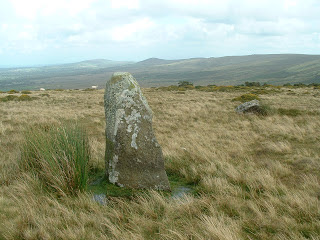
The famous painting by JC Young of the most prominent standing stone at Waun Mawn.  This one is not a part of the putative stone circle.

The standing stone at the northern edge of the putative stone circle.

In his latest (Bluestone Brewery) publication, Prof Mike Parker Pearson makes great play of the "equivalence" of the diameters of the putative stone circle at Waun Mawn and the outer ditch at Stonehenge -- claiming that both are 110m.  Clearly that is an attractive proposition if you are trying to prove that the Waun Mawn circle (if it existed) was a "proto-Stonehenge" and that it was dismantled here before being carted off to Salisbury Plain.

How realistic is it to make this link?

First up, as we have explained in other posts, the "proof" of a circle here is extremely shaky, and as the evidence currently stands, we cannot accept that there ever was a stone circle here. If there was, what diameter did it have, and how many stones might it have contained?

On the diameter, the essential problem is that there are only four stones that might be interpreted as part of an arc, and they are irregularly spaced and difficult to place on any circumference at all.  In his 2012 book MPP said on p 283:  "Andrew (Chamberlain" pointed out that the diameter and spacing of this possible former circle would have been almost exactly the same as that of the Aubrey Hole Circle at Stonehenge."  So in 2012 the calculations were that the circle had a diameter of c 86m.  Other older calculations placed the diameter at c 100m.  In 2017 MPP stated that the circle had a diameter of 115m, and in 2018 he said it was 110m.  My best calculation initially was that the circle might have had a diameter of 140m, although that would have taken the southernmost stones over the lip of the Waun Mawn "platform".


So there is a lot of disagreement as to how large the stone circle might have been.  However, MPP and his colleagues have obviously settled on 110m because that helps to establish a Stonehenge link -- and so the 2017 and 2018 digs were devoted to the investigation of a range of locations on a carefully surveyed circumference. This much is obvious from the 2018 map published by the Brewery.

This is the jolly map showing the positions of the existing stones and the so-called stone sockets described in 2018.  As we can see, the method of research used here is "assumptive research" -- in which the archaeologists have set out their hypothesis and then set out to find the evidence to prove it.    As we know, the "stone sockets" found are anything but convincing, and they have been designated as sockets largely because they are on, or close to, the circumference of the preferred circle.  In my view there are slight depressions, hollows and pits like this all over the Waun Mawn moorland, down to the undulating nature of the till and broken bedrock interface and down to small-scale stone extraction and rearrangement on the many prehistoric features which I have flagged up but which MPP and his team have ignored.  The evidence of a stone circle is scanty enough as it is, but where are the control digs on other parts of the moorland which might convince sceptics like me that the "sockets" enumerated are really unique and significant?

One final point.  The "matching" of the Waun Mawn "stone circle" with the circumference and diameter of the outer ditch at Stonehenge really is rather weird.  MPP and his colleagues are not talking of two stone circles that might be related, but one stone circle and one earthwork which did not, as far as we know, involve any stones.   By common consent, the outer ditch at Stonehenge was dug at a very early stage, at least 5,000 years ago.  The stone settings came much later, and if (as suggested by MPP) the Aubrey Holes held bluestones, the diameter of that circle must have been c 86m.

As far as we know, the stone circles of the British Isles are nearly all dated to the Bronze Age.  By suggesting a link between a Neolithic earthwork at Stonehenge and a possible Bronze Age standing stone setting at Waun Mawn, what is MPP getting at?  Is he really suggesting that the 110m diameter was something recorded and something significant?  Is he suggesting that the outer ditch measurement was somehow transmitted from Stonehenge to Waun Mawn and used for the setting of a 110m stone circle which was then dismantled and carted off to Stonehenge, where the bluestones were later used in a stone setting that was much smaller?  Or was the measurement first used at Waun Mawn and then transmitted to Stonehenge prior to the excavation of the outer ditch?

Does anybody have a clue what MPP is on about?  I grow weary, and need a cup of coffee.....

Friday, 30 August 2019

Another milestone -- 1.5 million page views


Just spotted the meter clicking up to the 1.5 million mark.  Thank you, good people, for your interest and encouragement!

Apparently the members of the archaeological establishment are blissfully unaware of the existence of this blog, and ignorant of all the things I have been saying about Stonehenge and the bluestones. They are slow learners...... and perhaps they only read and cite those articles that are approved by the thought police as being non-subversive.

Thursday, 29 August 2019

The bluestone hoax gets ever more elaborate

This is an updated version of an earlier post from last November:


The Waun Mawn developments now need to be highlighted as fitting neatly into the modus operandi of the research team.

===========================

Waun Mawn. If you try really hard, and mark out your 110m circle circumference, you can "find" a standing stone socket in the middle of this lot, and say that a bluestone 
monolith once stood in it.......

Rhosyfelin.  Does anybody else see a loading platform and a revetment here?  No?  Neither do I.


Carn Goedog.  Does anybody else see a stone-filled ditch, a platform and a pillar extraction point when they look closely?  No?  Neither do I.

Rhosyfelin.  Does anybody else see the "exact extraction point" from which a bluestone monolith pillar has been extracted?  No?  Neither do I.

Carn Goedog.  Does anybody else see evidence of a Neolithic quarry from which bluestone monoliths have been extracted?  No?  Neither do I.


Rhosyfelin.  Does anybody else see a quarrying forecourt and working surface here?  
No?  Neither do I.


Waun Mawn standing stone.  You can always pretend that this has been imported from a dolerite bluestone quarry some miles away -- and fail to mention that there are dolerite outcrops just 100m away, and dolerite erratics all over the place.

((I have another 50 or more photos showing natural features interpreted as having "engineering significance"  -- you'll find them in other posts on this blog.   I have resisted the temptation to put them all in here, since you would simply get bored..........))

The Art of the Scientific Hoax

I have done various posts on hoaxes before, including the following:

https://brian-mountainman.blogspot.com/2018/04/the-bluestone-quarries-great.html

Anyway, having observed the antics of various archaeologists (and geologists) over the last nine years, I am now completely convinced that the claimed “discovery” of Neolithic bluestone quarries in Wales is the most imaginative and professional hoax since Charles Dawson “discovered” Piltdown Man in 1912. (1)  The supposed "discovery" of the remains of a giant stone circle at Waun Mawn --designated as "proto-Stonehenge" -- has made the hoax even more elaborate (2).  What is possibly most impressive about it is that it has been built up systematically now over a period of nine years without any of the conspirators spilling the beans.........

Charles Dawson (sitting) at the site of his "earth-shattering" discovery........


It's a pity that scientific hoaxes have gone out of fashion, since they cause much embarrassment to the experts who are fooled by them and much innocent amusement for everybody else. Mind you, they don't do much for the reputations of the perpetrators -- although, if you are lucky, like Charles Dawson, you might be dead before you get rumbled.

As followers of this blog will know, year after year I have conducted — in all seriousness — a forensic examination of all of the evidence placed into the public domain by the archaeologists who claim that there are bluestone monolith quarries at Rhosyfelin and Carn Goedog in the Preseli uplands of Pembrokeshire and traces of a giant stone circle at Waun Mawn; and time and again I find that the evidence just does not withstand even superficial scrutiny (3). So I'm sure that the archaeologists, led by Professor Mike Parker Pearson of University College London, have pulled a fast one and have joyfully fooled the media, the public and a large part of the archaeological establishment.

For a scientific hoax to be successful, it requires four preconditions:

1. A gullible public predisposed to believe in “new discoveries” — in this case, stories about the great skills of our prehistoric ancestors and the meaning of Stonehenge.  In these days of alternative facts and false news, almost anything will grab the attention of the public.  The mere use of the word "Stonehenge" in a press release guarantees wide media coverage.

2. A colourful and swashbuckling lead character who has a respectable past and a strong media presence.  MPP is a popular figure who has been called the “Indiana Jones” of British archaeology, with a reputation for an endless stream of controversial theories.

3. A body of “evidence” cited in support of the hoax which cannot be checked or replicated by anybody else.  As far as I am aware, there was no independent scrutiny or peer review of the dig sites at Rhosyfelin, Carn Goedog and Waun Mawn while MPP and his team were at work between 2011 and 2018.   And the excavations have now been filled in, so that nobody can go back to them to check the cited “evidence”.  Wonderful!  That's a perfect scenario for a successful hoax……….

4. The ability to suppress or "drown out" anything inconvenient that might show up the hoax for what it is.  This can be achieved by doing deals with big business or grant-giving bodies which see that there would be large negative impacts for them should the hoax be exposed.  They will help you to promote the hoax and to suppress independent scientific research and conclusions.  You can also "drown out" inconvenient expressions of concern by using your contacts to repeat the hoax in print as often as possible and to develop it bit by bit in a way that can be represented as "hypothesis confirmation."   And of course you can vilify your opponents behind the scenes and use your establishment contacts to ensure that anything they write has little chance of being published.   This is all very jolly as long as you are not concerned about scientific ethics.

All four preconditions are amply fulfilled in this case.    

There has been extensive media coverage of the “bluestone quarries” and "proto-Stonehenge" since 2011, and this has ensured a considerable flow of research funding to finance eight digging seasons at the “quarrying” sites and elsewhere, as the archaeologists claim to have found “proto-Stonehenge” in the North Pembrokeshire landscape.  Interestingly enough, the breathless and uncritical coverage has come not just in the tabloid press but also in popular archaeological and historical magazines.  Even science journals which -- presumably -- have some respect for the scientific method, have been swept along in the torrent of fake news coming from the digging team and their university press offices.

https://www.manchester.ac.uk/discover/news/stonehenge-bluestone-quarries-confirmed-140-miles-away-in-wales/
https://www.telegraph.co.uk/science/2016/06/05/original-stonehenge-was-dismantled-in-wales-and-moved-to-wiltshi/
https://www.dailymail.co.uk/sciencetech/article-6018799/Ancient-WELSHMEN-helped-build-Stonehenge-5-000-years-ago-using-vast-bluestones.html
https://www.archaeology.org/issues/208-1603/trenches/4162-trenches-wales-stonehenge-bluestones
https://www.pourlascience.fr/sd/archeologie/lorigine-de-certaines-pierres-de-stonehenge-identifiee-au-pays-de-galle-12225.php

But clues as to what was going on were picked up at an early stage. The archaeologists who started digging at Rhosyfelin in 2011 announced before they broke the turf that they were investigating a quarry — which raised a few eyebrows. (Scientists do not normally announce their results before their research has started…..) At all stages of the dig, when I examined the open excavations in the company of other geologists and geomorphologists, we became more and more certain that all of the claimed “quarrying” or engineering features were entirely natural. Three of us published two peer-reviewed papers in 2015 containing our findings, but the archaeologists refused to acknowledge the existence of the papers, and even now, four years later, they will not admit that there is a dispute going on (4).  This is not just bad manners; it is scientific malpractice.

It gets worse.  After eight years of digging, not a single detailed field report has been published. There have only been two peer-reviewed journal articles, the first described by a senior academic as “one of the worst papers I have ever read” and the second equally suspect (5).  The radiocarbon dating evidence from the two "quarry" excavation sites does nothing to support the idea of quarrying, and has indeed been claimed to comprehensively falsify the quarrying hypothesis (6). No earth scientists have been systematically involved on-site in the annual excavations, which means that no serious questions have been asked when features have been interpreted as man-made. There have been no “control digs” at similar sites which migh demonstrate that the “quarrying" features are distinct or unique. And finally, not one of the many sites examined thus far for traces of “proto-Stonehenge” has proved to have anything to do with the iconic monument on Salisbury Plain (7).   The evidence for a ruinous stone circle at Waun Mawn is so thin that it should be dismissed.  Yet at every setback, the archaeologists have refused to back off,  have simply made their story more elaborate, and announced their next anticipated big discovery………..

So do the archaeologists still have any credibility? No.  Has the hoax finally run out of steam? Let us just hope so.

Here is a suggestion to the six senior members of the “bluestone quarries” project.  You've been rumbled.  Come clean, and admit that you have been enjoying a jolly prank with a serious intent in the background — namely to demonstrate how easy it is to promote a hypothesis that is underpinned by zero evidence.  Job done.  You should now, with smiles on your faces,  remind the public and the media that they should not necessarily believe things simply because they are repeated over and again, with apparent conviction, by senior academics.


NOTES

(1)
 Charles Dawson’s “Piltdown Man” hoax, perpetrated in 1912, is one of the most famous scientific hoaxes of all time. Dawson (with the aid of other persons unknown) fabricated bits of two human skulls and claimed that he had discovered, near the village of Piltdown, the “missing link” between apes and human beings. There were concerns about his “discoveries” but the hoax was not proven until 1953, many years after Dawson’s death in 1916.

(2)
Parker Pearson, M. et al. Waun Mawn 2018 interim report lite, Bluestone Brewery, 29 May 2019, 15 pp.

(3)
https://www.academia.edu/19788792/Quaternary_Events_at_Craig_Rhosyfelin_Pembrokeshire

https://www.academia.edu/19788912/Observations_on_the_supposed_Neolithic_Bluestone_Quarry_at_Craig_Rhosyfelin_Pembrokeshire

“The Stonehenge Bluestones”, 2018, Greencroft Books, 256 pp. ISBN: 978-0905559-94-0
http://www.brianjohn.co.uk/the-new-book.html

(4)
Parker Pearson, M., Pollard, J., Richards, C. and Welham, K., 2017. The origins of Stonehenge: on the track of the bluestones. Archaeology International, 20, pp.52–57. DOI: http://doi.org/10.5334/ai.353

(5)
 Mike Parker Pearson, Richard Bevins, Rob Ixer, Joshua Pollard, Colin Richards, Kate Welham, Ben Chan, Kevan Edinborough, Derek Hamilton, Richard Macphail, Duncan Schlee, Jean-Luc Schwenninger, Ellen Simmons and Martin Smith (2015). Craig Rhos-y-felin: a Welsh bluestone megalith quarry for Stonehenge. Antiquity, 89 (348) (Dec 2015), pp 1331-1352.
https://eprints.soton.ac.uk/421631/1/Megalith_quarries_Antiquity_REVISED.pdf

Mike Parker Pearson , Josh Pollard , Colin Richards , Kate Welham , Chris Casswell, Charles French, Duncan Schlee, Dave Shaw, Ellen Simmons, Adam Stanford, Richard Bevins and Rob Ixer.
Megalith quarries for Stonehenge's bluestones.
Antiquity, Volume 93, Issue 367
February 2019, pp. 45-62
https://www.cambridge.org/core/journals/antiquity/article/megalith-quarries-for-stonehenges-bluestones/AAF715CC586231FFFCC18ACB871C9F5E

MPP, National Geographic and Bluestone Brewery


We are all very familiar with the links between MPP and his team and the National Geographic -- one of a small group of "mega sponsors" who put in large sums of cash into archaeological projects (including digs) in exchange for certain exclusive rights.

What is rather more interesting is the link established in recent years between the MPP team and the local micro brewery, just up the road. Our good friends Simon and Kerry (and their family) are making a great success of it, expanding their range of beers all the time, and organizing a vast range of convivial events as well, much to the delight of both visitors and locals.  Their web site is here:

https://www.bluestonebrewing.co.uk

The brand name says it all, and I suppose it was always inevitable that the link between bluestones and Stonehenge would feature prominently in their marketing.  All credit to them for that.  Their brews go under such names as Hammer Stone, Bedrock Blonde, Rocketeer, Rock Hopper, Cave Dweller and Summer Rocks -- and the label graphics always flag up the craggy, rock-hard, angular and rather macho nature of the brews -- apart from some specifically aimed at the ladies!

 So rocks, cave men and prehistoric monuments are in --  but instead of concentrating on geology and  good solid evidence as part of the marketing campaign, the Brewery has gone for archaeological fantasies instead, and has more or less adopted MPP and his jolly gang, who of course enjoy a jar or two of ale after a hard day of digging just up the road.  All of the dig sites -- and in particular Craig Rhosyfelin, Carn Goedog and Waun Mawn -- are just a few miles away.  Mike has given at least one talk per year at the Brewery since the diggers first arrived in the neighbourhood in 2011.  To his credit, he gives the talks for free, to raise money for charity --so that is entirely admirable.

But of course there is two-way traffic here -- the Brewery benefits from the drinking expenditures of the diggers, and from the crowds attracted to his talks (the most recent one was on July 27th this year)  and Mike benefits from enhanced exposure to the public, via the Brewery's very effective PR and marketing campaigns.  Win / win scenario........

What is more intriguing is that the Brewery has in effect become the publisher for the "interim research findings" of the 2018 Waun Mawn digging season.  The "2018 Interim Report Lite" is, as far as I can make out, ONLY available to the public, for scrutiny, via the Brewery web site.  And if this is the "Lite" version, where is the heavy one?  Has anybody seen it?  Does it exist?

This is all very entertaining, in a bizarre sort of way.  But I wonder whether the Brewery has ever paused for a moment, in its zealous promotion of MPP and his ideas, to consider the possibility that all of this bluestone quarrying stuff, not to mention the speculations about the Waun Mawn "giant circle", is nothing more substantial than a hoax?  History is sadly full of examples of heroic celebrities being adopted or signed up by popular brands before proving to be, for one reason or another, more than a little toxic.

The Brewery knows that Mike's ideas are controversial and that they are hotly disputed -- but the current preference is to pretend that he is uniquely in possession of the truth.  Good marketing?  Maybe.  But bad science.

Anyway, I'm very happy to promote the Brewery via this blog, even though I cannot stand the taste of ale!