Tuesday, 9 February 2010

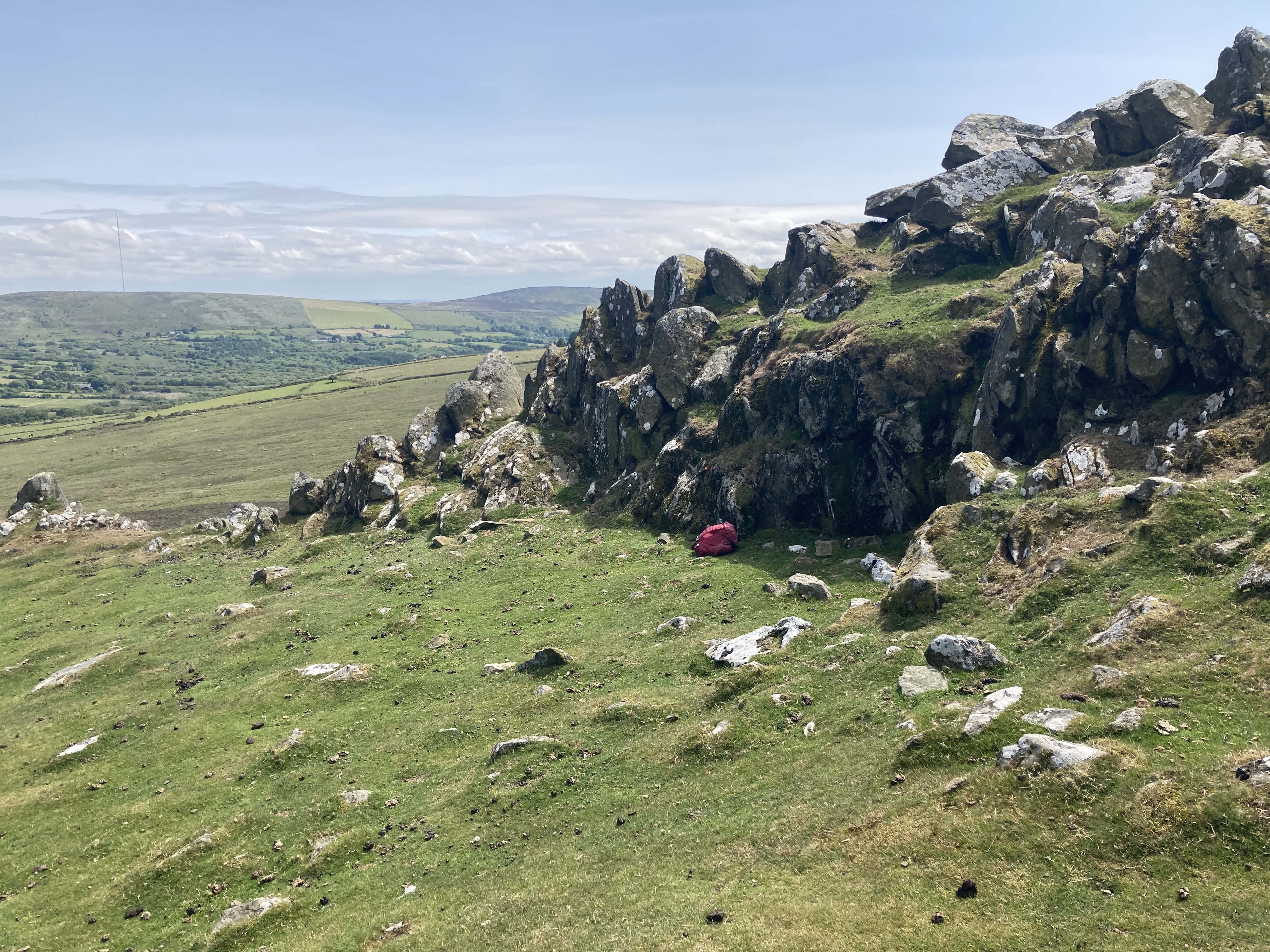
Cairns near Carn Meini


One of the cairns on Craig Talfynydd

Another part of the recent "Spaces" report on AW, by Darvill and Wainwright and colleagues, refers to the cairns in the vicinity. I have no problem with those -- there are several, and they are easy to spot. They are assumed to be Bronze Age. Of course, the "construction" of those cairns would have involved a certain amount of stone collecting and maybe excavating into the stony ground -- I would still not use the word "quarrying". So stones would have been moved about and put into piles, or tastefully arranged in other ways. But I can still see no reason whatsoever to think that any of the stone movement in the vicinity was for "export purposes" to Stonehenge or anywhere else. That is an absolutely unnecessary and unsupportable hypothesis.

More about "quarries" and "sacred springs"


One of the "springheads" -- is this supposed to be a "construction"? If so, can we please have some evidence?

Our old friends Profs Darvill and Wainwright have just produced another Report on their "Spaces" project in Pembs -- in "Archaeology in Wales" -- and as one might expect it is full of assumptions about quarries and sacred springs. Typical quotes:
"In 2007 five further springheads were recorded on the west and north side of Carn Meini. Most are of similar construction to those previously recorded with a crude wall screening off the springhead, thus creating a basin from which the streams run downslope."

"Similar construction"??? They see constructions where others see natural features.

"An incline was recorded on the north-west corner of Carn Meini below the western crag associated with two abandoned pillar stones and a pile of quarry debris. Stone-filled pits may represent extraction holes later filled with debris from dressing the stones".

Inclines, stone-filled pits and debris from dressing stones? Oh dear oh dear. I venture to suggest that there is not a scrap of evidence for any of this. We are on a slope, which tends to have inclines on it. What I see when I look everywhere in this area is a periglacial landscape, with frost-shattered surfaces, some of which are ice-smoothed by overriding ice, and broken slabs and scree all over the place. I don't deny that there might have been some stone removal at some stages (including within living memory) but why anybody should think this has anything at all to do with Stonehenge is a mystery to me........

Saturday, 6 February 2010

The Stonehenge moraine?


Now this is interesting! Yet more info coming out... and this time we have a shrubbery and a mound. It's interesting that Mike Pitts thinks the mound might have been "a natural geological feature" -- could this be the Stonehenge moraine that provided the incentive for the monument to be built here in the first place, and which also provided a ready source for at least some of the stones? That might sound rather fanciful -- but let's see what the evidence is.......

=========================
From the Guardian newspaper, 4 Feb 2010
Stonehenge's secret: archaeologist uncovers evidence of encircling hedges

Survey of landscape suggests prehistoric monument was surrounded by two circular hedges

The Monty Python knights who craved a shrubbery were not so far off the historical mark: archaeologists have uncovered startling evidence of The Great Stonehenge Hedge.

Inevitably dubbed Stonehedge, the evidence from a new survey of the Stonehenge landscape suggests that 4,000 years ago the world's most famous prehistoric monument was surrounded by two circular hedges, planted on low concentric banks. The best guess of the archaeologists from English Heritage, who carried out the first detailed survey of the landscape of the monument since the Ordnance Survey maps of 1919, is that the hedges could have served as screens keeping even more secret from the crowd the ceremonies carried out by the elite allowed inside the stone circle.

Their findings are revealed tomorrow in British Archaeology magazine, whose editor, Mike Pitts, an archaeologist and expert on Stonehenge himself, said: "It is utterly surprising that this is the first survey for such a long time, but the results are fascinating. Stonehenge never fails to reveal more surprises."

"The time these two concentric hedges around the monument were planted is a matter of speculation, but it may well have been during the Bronze Age. The reason for planting them is enigmatic."

Pitts wonders if the hedges might have been to shelter the watchers from the power of the stones, as much as to ward off their impious gaze.

If the early Bronze Age date is correct, when the hedges were planted the Stonehenge monument already had the formation now familiar to millions of tourists, after centuries when the small bluestones from west Wales and the gigantic sarsens from the Stonehenge plain were continually rearranged.

The survey also found puzzling evidence that there may once have been a shallow mound among the stones, inside the circle. It was flattened long ago, but is shown in some 18th century watercolours though it was written off as artistic licence by artists trying to make the site look even more picturesque. The archaeologists wonder if the circle originally incorporated a mound which could have been a natural geological feature, or an even earlier monument.

Monday, 25 January 2010

The Great Bluestone Hunt


This is the area where, I suspect, real progress is likely to be made in the coming years. The area shown in yellow is the approx area of the "Fishguard Volcanics" on the northern flank of Mynydd Preseli -- here, as I have indicated, there are complex extrusive rocks thrown out during Ordovician volcanic eruptions -- and some intrusives too. Typical rocks are rhyolites, breccias, ignimbrites, tuffs and welded tuffs -- and because some of the eruptions were in the sea, there are layers of detritus and pebble beds that look more like sedimentary rocks than igneous ones. The map is not very accurate -- there are certainly some ashes and other volcanics exposed in the coastal cliffs between Cwm-yr-Eglwys and Newport.

I wouldn't mind betting that some of the igneous fragments from the Stonehenge area will be matched up with rocks from these Fishguard Volcanic Series outcrops. Secrets out there, waiting to be discovered........

The latest geological revision by Ixer and Bevins


Photos: Top: Carnedd Meibion Owen. Middle: Pont Saeson ford. Lower: Pentre Ifan cromlech.


The interesting thing about this work is that it shifts attention to a large area of North Pembrokeshire, to the north of the Presely Hills, where there are many outcrops of flinty rhyolites and related igneous rocks. Some of the rhyolites are quite clean and coloured with beautiful blues and greens, with slate-like cleavage, and others are more massive, with very complex crystal structures. I have seen such rocks around Tycanol Woods, on Carnedd Meibion Owen, at Brynberian and Crosswell, and around the famous cromlech at Pentre Ifan. I wonder what the geologists will find next?


===========================
From British Archaeology, Nov / Dec 2009

Important revision to Stonehenge bluestone theory

In the News pages of the Nov/Dec 2009 issue of British Archaeology, it is reported that new petrographical work by Rob Ixer (University of Leicester, Department of Geology) and Richard Bevins (National Museum of Wales) had suggested that some of the Stonehenge bluestones had not come from Pembrokeshire, but (in Ixer's words) from "a far wider and, as yet, unrecognised area or more likely areas". As the magazine was being printed, however, Bevins was out in the field, and found an apparent source for the rocks in question north of the Preselis. Ixer and Bevins have kindly written this interim note on this latest development.
-------------------
Stilpnomelane-bearing rhyolites/rhyolitic tuffs at Stonehenge are most probably from the Preseli Hills region
-----------------------------------------

Field and petrographical work continues on new Stonehenge lithics and on in situ material from areas around the Preseli Hills. This includes excavated material from the Avenue at Stonehenge, and rocks from undistinguished outcrops in the low ground north of Mynydd Preseli, close to Pont Saeson.

The former, as expected, conformed to the range of lithologies seen throughout Stonehenge. But the latter had surprising results, and has led to our radically modifying our proposal that many of the bluestones do not have a Preseli Hill origin, but have an unknown and possibly non-southern Welsh origin.

In thin section the Pont Saeson fine-grained acidic rocks show most of the features of our class of Stonehenge rocks, informally called "rhyolite with fabric", including a lensoidal fabric and the presence of stilpnomelane. Despite nearly a century of collecting and analysis, this is the first record of this mineral in rhyolitic rocks in south Wales. The only previous recorded occurrences of stilpnomelane in acidic rocks in Wales are from the Cregenen granophyre in the Cadair Idris area of southern Snowdonia, and in granophyric rocks of the St David’s Head Intrusion, in north-west Pembrokeshire.

Although not an exact match for the Stonehenge rocks, the Pont Saeson lithics strongly suggest that the "flinty rhyolite/rhyolite with fabric" found in the excavations at Stonehenge has an origin in the Preseli region, and that there is no longer a need to look further north in Wales for this important class of Stonehenge debitage.

The other and more abundant unusual rock-type (carrying distinctive titanite-albite inter-growths) from the Great Cursus area (but not so far identified at Stonehenge) is still unprovenanced, and its petrography has still yet to be matched with rocks from south Wales, or indeed from the rest of Wales.

An interim summary of where we now believe the Stonehenge bluestones come from, and incorporating these new data, is:

* Spotted and unspotted dolerites, the flinty rhyolite/rhyolite tuffs and possibly the basaltic tuffs have a Preseli origin, but a search for their associated source rocks must no longer be restricted to the prominent outcrops on the Preseli Hills
* The Altar stone Devonian sandstone – the largest bluestone – cannot be from the Preseli region
* The rare other sandstone orthostats comprising a Palaeozoic sandstone are also not from the Preseli Hills, but may be southern Welsh in origin
* The titanite-albite-bearing rhyolitic rocks have yet to be sourced, but it is now anticipated that they too will have come from the Preseli region; only detailed and dedicated collecting and petrography will be able to prove that.

Rob Ixer & Richard Bevins

The Pont Saeson connection


Been to have a look at Pont Saeson, between Brynberian and Crosswell in North Pembrokeshire -- whence Richard Bevins took his rock samples which have now been matched up with rock fragments from the Stonehenge area. The interesting thing about this area is that there are no upstanding tors or craggy hills at all -- the landscape is gently undulating, with a couple of deep river valleys which have within them smallish outcrops of rhyolite on the slopes. In one place, pictured above, there is a prominent "spur" or crag of rhyolite, not far from the Pontsaeson ford, which owes its prominence to stream action -- and maybe to subglacial fluvial action during one of the glacial episodes that affected the area. But even this spur is within the valley -- it does not project above the overall land surface.

It is clear that the entrainment of erratics into the base of an overriding glacier could have occurred here -- but I can see no reason whatsoever why any Neolithic tribesmen would ever wish to take a stone, or a collection of stones, from an innocuous and undistinguished location such as this. Here, it just does not make sense -- even though there may some attraction in the idea (put forward with great enthusiasm by HH Thomas and Richard Atkinson) that the Stonehenge bluestones were taken from "sacred hills" or prominent high points in the landscape -- like Carn Meini -- which might have been treated with reverence by passing traders.

Another thumbs-down for the crazy human transport theory........

Tuesday, 29 December 2009

The great Millennium Stone Pull


Came across this picture in my photo album -- which reminded me just how idiotic this whole theory about the human transport of the stones actually is. If HH Thomas had not dreamt up the whole silly notion, just think what a lot of human effort might have been spared -- millions of words in print, endless debates on blogs and forums, vast sums spent on reconstruction projects, and the same old stuff going round and round, with people in general fascinated by the idea of ancient tribesmen invested with extraordinary engineering skills, stupendous imagination, and incredible social and economic motivation -- not to mention the navigational and maritime skills used in treacherous coastal waters with high tidal ranges, mudflats, storm waves and roaring currents.

I thought for a long time that it was a fine thing to engage in some of the Stonehenge blogs, on the basis that discussion would lead all of us eventually to the truth........ but no matter how one attempts to address the real issues of engineering and motivation, and no matter how much one tries to debate the glacial ("alternative") theory, people will insist on going right back to square one and asking "I wonder how they did it?" and coming up with endless theories, apparently without ever stopping to ask the questions "Did they do it?" and "Is it necessary to speculate on this anyway?"

The picture above shows how difficult it was to control one smallish bluestone on a sledge, on a moderate slope, during the "Millennium Stone" pull in the year 2000. With the aid of netlon (low-friction netting), modern ropes, asphalt roadways and help from cranes, JCBs and modern boats, the project was still a shambles that left the stone on the bed of Milford Haven.

Here's a proposal -- forget about the human transport altogether. Pretend that the daft idea had never even been thought of. And concentrate all the formidable brain power of the people of the planet (well, a little bit of it anyway) on solving the riddle of how natural processes carried some of the Stonehenge "bluestones" from West Wales to Somerset and Wiltshire. Jim Scourse and Chris Green have declared -- in print -- that it was "impossible" for natural processes to have been responsible for this entrainment and transport. Not a word one should use lightly........