THE BOOK
Some of the ideas discussed in this blog are published in my new book called "The Stonehenge Bluestones" -- available by post and through good bookshops everywhere. Bad bookshops might not have it....
To order, click
HERE
Showing posts sorted by relevance for query Altar Stone. Sort by date Show all posts

Thursday, 23 July 2020

Geological Notes on the Altar Stone paper


An EH photo of the surface of the Altar Stone, visible between fallen sarsens 156 and 55b (trilithon 55 is broken into two portions of almost equal size.)  There are some doubts about its dimensions -- most references quote approx 4.9m x 1.5m x .5m -- but one EH publication refers to it as being 3m wide, which means it should be referred to as a slab and not a pillar.


An extract from Anthony Johnson's excellent plan of the Stonehenge stones.  The Altar Stone is stone 80, with two sarsens lying across it.  

Geological Notes on the Altar Stone paper


It’s good to get some comments from another geologist who has actually studied the Altar Stone and the Devonian sandstones of West Wales. I’ve been in correspondence with Richard Thomas, who now lives in Newfoundland, for some years. Last time he visited Wales, he managed to fit in a visit to Rhosyfelin as reported here: https://brian-mountainman.blogspot.com/2018/04/another-rhosyfelin-sceptic.html

Key stratigraphic and lithological information is here:
http://www.bgs.ac.uk/Lexicon/lexicon.cfm?pub=COB

This is the paper being discussed:

Constraining the provenance of the Stonehenge ‘Altar Stone’: Evidence from automated mineralogy and U–Pb zircon age dating.
Richard E. Bevins, Duncan Pirrie, Rob A. Ixer, Hugh O’Brien, Mike Parker Pearson, Matthew R. Power, Robin K. Shail
Journal of Archaeological Science 120 (2020), 105188

Here are some of Richard’s points:

I found the paper very interesting, and we should commend Rob Ixer and Richard Bevins for all the hard work they have put into the provenancing of the Altar Stone.

I have suggested to the authors that there are two fundamental provenancing issues:

(1) the epic task of unequivocally identifying the parent formation and source location of the Altar Stone (Stonehenge Stone 80);

(2) proving whether or not the sandstones comprising the Altar Stone and the so-called "Altar Stone debitage" are indeed one and the same -- i.e., were derived from a single, lithostratigraphic source unit. Neither issue can be completely resolved unless fresh samples are obtained for analysis from the Altar Stone itself.

I'm under the impression that no indisputably genuine thin sections of the Altar Stone are known to exist. As summarised by Ixer et al. (2019, p.1): "It is not certain that the Altar Stone has been directly sampled, certainly not in the last two centuries, and all samples labelled Altar Stone in museum collections appear to be from loose fragments/debitage and designated as 'Altar Stone' by 19th- and 20th-century excavators." However, in an earlier paper, Ixer and Turner (2006, pp. 2-3) state that: "...the thin section labelled '277 Altar Stone Stonehenge' is ....the only piece of the monolith available for investigation." With respect to issue (2), the various Altar Stone-related papers (including Bevins et al., 2020), contain references to the parentage of the samples described that I find somewhat confusing and, at times, contradictory. For example, on p.1: " .... mineralogical data from proposed Stonehenge Altar Stone debris..."; p.3: "..three debris samples, also thought to be derived from the Altar Stone."; p.3: "..the second type of sandstone, found as rare debris at Stonehenge as well as comprising the Altar Stone..."; p.3: "...six of which have been identified petrographically as being derived from the Altar Stone..."; p.5 (Table 2 caption): ".....samples analysed in this study from the Stonehenge Altar Stone.."; p.7: "...the samples interpreted as derived from the Altar Stone..."; p.7: "...the three Altar Stone samples..."; p.11 "...the so-called Altar Stone sandstone..."; p.12: "...study of the clay mineralogy of the Altar Stone sandstone...". In a similar vein, from Ixer and Bevins (2013, p.14): "...potential Altar Stone debitage ..."; "Three typical Altar Stone debitage lithics.."; "...it is now possible to provide a 'standard' petrographical description for the Altar Stone...”.

This seems to me to be a case of mixed messaging. Ixer and Bevins are trying to prove that sandstone samples such as SH 08, HM 13 and FN 573 are identical to, and/or derived from, the Altar Stone, but how is that possible without having an absolutely bona fide Altar Stone sample for comparison? To eliminate any ambiguity, I think all supposed Altar Stone sandstone samples should have qualifiers such as: 'suspected', 'potential', 'purported', 'possible', 'so-called', etc. added to their descriptions. Unless, of course, 277 is the real McCoy (see below).

One technical point: it's the Mill Bay Formation that is the bio- and lithostratigraphic equivalent of the Senni Formation of the Brecon Beacons area, and not the entire Cosheston Subgroup.

The key point of the paper: Ixer and Bevins have confirmed in the new paper that the analysed micaceous sandstones from the Stonehenge Landscape were not derived from the Mill Bay Fm. section at Mill Bay. The underlying, 435-550m-thick Llanstadwell Fm. also contains numerous green, highly micaceous sandstone units although personally, I don't think they're a match for the Altar Stone either.

From the location information in Ixer et al., 2020 (p.10), it's clear that sample MB3 collected by Brian John actually came from the lower Lawrenny Cliff Fm. -- which explains its compositional differences from the other Mill Bay samples. According to my old field notes, the junction between the two formations (underlying Mill Bay Fm and overlying Lawrenny Cliff Fm) crosses the HWM about 60m south-west of the Whalecwm slipway.

Regarding Ixer et al., 2019 (p.4), my macroscopic description of the Altar Stone (included in Thorpe et al., 1991) was based on me crawling over it and taking photographs (back in January, 1973). I never looked at the samples described by Huggett (1993).

QEMSCAN is a great tool -- especially when used to complement thin section optical mineralogy. The latter will still be essential for determining the Altar Stone's provenance. Using it you can quickly rule out potential source rocks. For example, it only took me a minute to realise that OU9 (444) was not a Cosheston sandstone. Likewise, as you know, verifying whether (p.7) "...quartz and albite cementation, or grain boundary dissolution may also have occurred..." would be simple in thin section. In my view, the fact that QEMSCAN 'reports' rock fragments as their constituent minerals is a major shortcoming, particularly since intraformational and extraformational lithoclasts are such a common component of most Anglo-Welsh ORS sandstones. I suspect that thin section analysis of the diagenetic histories of possible source sandstones will play an important role in unravelling the Altar Stone's provenance. Carbonate cements (including poikilotopic calcites) are common in the Senni Fm. and tend to preferentially attack certain minerals or rock fragments (e.g., K-feldspars), meaning that modal analyses can't give you a true picture of the original composition of the framework-grain fraction. Thin section work, in tandem with QEMSCAN, will be the key to identifying any given sandstone's diagnostic, compositional and textural 'signature' for comparison with those of potential source units.

Quote from P.7: "Clay minerals in sandstones may occur as a detrital matrix or as ......diagenetic cements." They also, of course, occur as claystone or fine siltstone intraclasts, and as alteration products.

Could there be any other cryptic "species" of sandstones among the Stonehenge Landscape debitage?

Is the famous slide 277 really a thin section of the Altar Stone? When I looked at this thin section, I felt that it didn't match what I'd expect a genuine Altar Stone specimen to show. This sandstone is finer grained (very fine vs. fine sand grade) and a lot less micaceous than the Altar Stone, and only contained a couple of garnets. I think it unlikely that it is a genuine Altar Stone sample.

I have no problem agreeing that the "Altar Stone" samples (Table 2; Figs. 2-5 and 8) -- especially FN 573, HM 13 and SH 08 -- share the same parentage. Again, the key question is whether they share that parentage with the Altar Stone. From an inspection of Table 2 and Fig. 2, I'm sceptical that the six numbered samples were derived either from the Altar Stone or its parent unit. Two compositional issues bother me:

(1) Thomas (1923, p.244) describes the Altar Stone's heavy mineral suite as being "exceedingly rich in garnet" which I interpret as being on a par with garnetiferous Llanstadwell Fm. and (especially) Mill Bay Fm. sandstones. However, the analyses indicate that the garnet content of the two Mill Bay Fm. sandstones is an order of magnitude greater than that of the supposed "Altar Stone" samples;

(2) the Altar Stone (from my field inspection) contains abundant muscovite -- certainly equal to the muscovite content of most 'lower' Cosheston Subgroup sandstones. From Table 2, Mill Bay 1a and 1b (average = 4.88%) contain close to double the amount of muscovite present in the six "Altar Stone" samples (average = 2.48%). I consider these differences to be significant grounds for suspecting that the latter are not of genuine Altar Stone derivation. However, this question can only be resolved when/if English Heritage allows new Altar Stone samples to be collected.

Burl (2007, p.281) gives the length, width and thickness of the Altar Stone as 5.0m, 1.1m and 0.53m, respectively. If I remember correctly, the latter's small-scale, trough cross-lamination indicates it is lying right way up stratigraphically. I'd suggest that two samples of the Altar Stone be taken: one from near the stratigraphic top of the unit and one near its base. Both sample sites would be hidden from public view (beneath the turf) because the top sample would have to be taken below the upper portion of the Stone that has been damaged/mineralogically altered by the fires lit upon its exposed surface.

Most Senni Fm. in-channel sandstone bodies that I have observed, generally fine upward. When sampling potential Altar Stone source units, it will be extremely important to ensure that the grain-size distributions of the sandstones collected match that of the Altar Stone as closely as possible, so that compositional differences related to hydraulic equivalence are minimised.

Senni Fm. sandstones vary in colour, provenance, distance from sediment source(s) and diagenetic history from West to East across the Formation's outcrop. I agree with Ixer and Bevins that the eastern portions of its outcrop are the most promising in terms of potential Altar Stone source units. It may be worthwhile checking for any fracture pattern differences across the outcrop, in order to locate joint systems capable of "releasing" sandstone blocks up to 6m long and up to 0.6m in thickness.

The zircon images and date ranges published in the new paper are fascinating! P.8: "A simple interpretation is that the Altar Stone grains reflect a more mature sedimentary environment.....". I suspect that provenance differences are a more likely explanation for the observed 'disparity' in zircon morphologies. The range in zircon morphology and their ages furnishes additional evidence of the prevalence of multicycle detritus within the Cosheston Subgroup sequence (cf. Thomas et al., 2006). The greater range of ages represented by the"Altar Stone" micaceous sandstone zircons is very interesting and suggests a geologically complex source area for these rocks and/or the availability of an abundance of second- and multi-cycle detritus.

I am a strong proponent of the glacial transport of the bluestones to a 'greater Stonehenge' catchment area rather than human transport, and consider the archaeologists' 'new' land route proposal (apparently signed up to by Ixer and Bevins) to be completely lacking in credibility. Also, during my visit to Craig Rhos-y-felin I could find no evidence in support of quarrying at the site.

-----------------------------------------

Most of Richard's observations are of a technical nature,  but it's interesting that, like me, he takes issue with the assumption that all of the supposed "Altar Stone samples" have actually come from the Altar Stone,  and like me he feels that the authors of the paper should have been much more circumspect in their wording.   We also share concerns about the promotion (yet again!) of the human transport hypothesis, and about the presumption that there is a man-made Neolithic quarry at Rhosyfelin.  On the other hand we are both happy that the "Altar Stone" samples probably do come from a common source; that the sampled debris did not come from the Mill Bay Formation;  and that the real provenance of the "Altar Stone" fragments probably lies somewhere in the eastern part of the Senni Beds outcrop, far away from Preseli.  As I have said before, ice from that area flowed on more than one occasion southwards and south-eastwards towards the Severn Estuary,  so this new work does nothing at all to dent the glacial transport hypothesis.

Friday, 6 May 2022

The Altar Stone may NOT have come from Wales

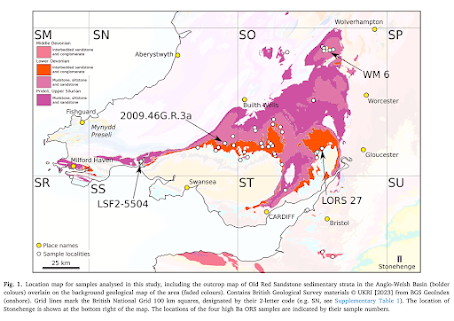
ORS outcrops and (marked by triangles) the locations of ORS beds sampled and used for comparative purposes with the Altar Stone surfaces and with associated debitage fragments at Stonehenge.


A friend attended a talk by Richard Bevins the other day, at which he highlighted this latest piece of research on the Altar Stone:

"Linking derived debitage to the Stonehenge Altar Stone using portable X-ray fluorescence analysis."
Richard E. Bevins, Nick J.G. Pearce, Rob A. Ixer, Stephen Hillier, Duncan Pirrie and Peter Turner
Mineralogical Magazine (2022), 1–13
doi:10.1180/mgm.2022.22
Published online by Cambridge University Press: 22 March 2022


https://www.cambridge.org/core/journals/mineralogical-magazine/article/linking-derived-debitage-to-the-stonehenge-altar-stone-using-portable-xray-fluorescence-analysis/23E9A00C0C2B9FAC0BC74AC11AAE5B2D

Abstract

The Altar Stone at Stonehenge in Wiltshire, UK, is enigmatic in that it differs markedly from the other bluestones. It is a grey–green, micaceous sandstone and has been considered to be derived from the Old Red Sandstone sequences of South Wales. Previous studies, however, have been based on presumed derived fragments (debitage) that have been identified visually as coming from the Altar Stone. Portable X-ray fluorescence (pXRF) analyses were conducted on these fragments (ex situ) as well as on the Altar Stone (in situ). Light elements (Z<37) in the Altar Stone analyses, performed after a night of heavy rain, were affected by surface and pore water that attenuate low energy X-rays, however the dry analyses of debitage fragments produced data for a full suite of elements. High Z elements, including Zr, Nb, Sr, Pb, Th and U, all occupy the same compositional space in the Altar Stone and debitage fragments, and are statistically indistinguishable, indicating the fragments are derived from the Altar Stone.  Barium compares very closely between the debitage and Altar Stone, with differences being related to variable baryte distribution in the Altar Stone, limited accessibility of its surface for analysis, and probably to surface weathering.

A notable feature of the Altar Stone sandstone is the presence of baryte (up to 0.8 modal%), manifest as relatively high Ba in both the debitage and the Altar Stone. These high Ba contents are in marked contrast with those in a small set of Old Red Sandstone field samples, analysed alongside the Altar Stone and debitage fragments, raising the possibility that the Altar Stone may not have been sourced from the Old Red Sandstone sequences of Wales. This high Ba ‘fingerprint’, related to the presence of baryte, may provide a rapid test using pXRF in the search for the source of the Stonehenge Altar Stone.

Conclusions

We tested the potential link between debitage fragments from excavations at Stonehenge identified visually as being derived from the Stonehenge Altar Stone by pXRF to ascertain if the vis-ual link was valid. The Altar Stone was analysed in situ on a wet morning following a night of rain, contrasting with the ex situ, dry setting for the debitage fragments. Accordingly, the surface of the Altar Stone at the time of analysis was wet. This caused attenu- ation of the signal for light elements (below Z=37). However, strong correlations for elements above Z = 37 leads us to conclude that the fragments were indeed derived from the Altar Stone. This shows that even though there are widely publicised concerns over the pXRF technique, in this case it did provide a credible geochemical comparison between the derived fragments and source monolith and highlights the value of the technique in this particular archaeological context. In addition, being a non-destructive technique, it does not compromise the integrity of the ancient monument.

Having matched the derived fragments to the Altar Stone we are now in a position to interpret with confidence the data obtained to date on the derived fragments in the search for the source of the Altar Stone. The pXRF results showed the Altar Stone to have high Ba contents which is in agreement with the high modal % baryte identified previously using automated SEM-EDS analysis. This rather unusual mineralogy will be a key element in our search for the origin of the Altar Stone.

-------------------------------------

We have known about this research for some time -- and indeed it has been obvious for years that pXRF analyses had to be done on the Altar Stone exposed surfaces.  So it's good to see the research published at last.  Thankfully, this is a straight geology paper unsullied by any archaeological speculation about stone transport mechanisms or haulage routes.  

I need to read the paper more carefully, but for me the stand-out features are as follows:

1.  It now seems probable that the fragments at Stonehenge assumed to have come from the Altar Stone did indeed come from it -- but as far as the specialists are concerned, I suspect that the jury is still out.  The researchers had a problem in that their sampling work on the exposed surfaces of the Altar Stone was done in extremely wet conditions, whereas the fragments were studied dry.  To the untrained eye (such as mine) there seem to be substantial differences between the mineralogy of the fragments and the stone surfaces (Figure 3) -- and I was not all that convinced by the convoluted arguments in the text which put the differences down largely down to wet / dry sampling errors.

2.  Having promoted very heavily the idea that the Altar Stone came from the Senni Beds somewhere in mid Wales or the Welsh Borders, Bevins, Ixer and their colleagues now seem to have abandoned that idea altogether. That's quite a lesson for them and for everybody else as well -- the provenencing of erratic boulders (or Stonehenge bluestone monoliths) is only as good as your sampling density allows it to be.  As I have agued over and again, there is no way that Bevins and Ixer have provenanced spotted dolerite monoliths to Carn Goedog or foiliated rhyolite fragments to Rhosyfelin, because they still do not know where all the outcrops are.

3.   All this throws the provenencing of the Altar Stone up into the air again, with the intriguing possibility that it might actually be rather local -- having come, quite possibly, from no further away than Frome............

Saturday, 1 December 2018

New paper on the Altar Stone -- or is it?


There is a new pre-publication paper on the Altar Stone, with a 2019 date attached.  Details as follows:

Alternative Altar Stones? Carbonate-cemented micaceous sandstones from the Stonehenge Landscape

by Rob Ixer, Richard Bevins, Peter Turner, Matthew Power and Duncan Pirrie 

Wilts Arch and Nat Hist Mag 112 (2019), pp 1-13
ABSTRACT

The six-tonne recumbent Altar Stone is perhaps the most enigmatic of all the Stonehenge bluestones, differing markedly from the others in size, tonnage, lithology and origin. It has therefore had more than its fair share of speculation on all of these aspects and many questions remain: was it always recumbent, was it a singleton or half a twin, where did it come from? Clearly it is not from the Preseli Hills hence the debate as to its geographical origins for over a century. However, any provenancing of the Altar Stone must rely on a detailed and accurate lithological and petrographical description. New descriptions of material labelled ‘Altar Stone’ held in museum collections and a re-evaluation of suggested Altar Stone debitage using automated scanning electron microscopy and linked energy dispersive analysis using QEMSCAN technology suggests that modification of the published petrographical descriptions is needed. A new ‘typical Altar Stone’ description is provided including the presence of early cementing barite and a better characterisation of the clay content. These new data should continue to narrow the search for the geographical origin of the Altar Stone, one that is expected to be at the eastern end of the Senni Formation outcrop, an outcrop that reaches as far east as Abergavenny in the Welsh Marches.

Here is the URL:
https://www.academia.edu/37882770/Alternative_Altar_Stones_Carbonate-cemented_micaceous_sandstones_from_the_Stonehenge_Landscape 

As fellow bloggers will know, we have spent a lot of time on this blog pondering on the origins of the Altar Stone, and on the relationship of the stone itself with assorted samples claimed to have come from it.  One of the biggest mysteries relates to "sample 277"  -- assumed but never proved to have come from the stone:

https://brian-mountainman.blogspot.com/2016/12/could-altar-stone-have-come-from.html


When Ixer and Turner published their "definitive" paper on the Altar Stone in 2006 they were criticised for assuming that "sample 277" was from the only reliably provenanced piece of Altar Stone available -- and for assuming that in describing its characteristics they were describing the true characteristics of the Altar stone and its petrography.  They said at the time:  ".........the thin section labelled ‘277 Altar Stone Stonehenge’ in the Salisbury Museum Collection is likely to remain, for the foreseeable future, the only piece of the monolith available for investigation. It is imperative then that it should be described as fully as possible and that this description becomes widely available."

This last sentence contains the justification for the writing of the paper.

But the authors also said:

This paper represents the first detailed description of the Altar Stone for over eighty years and is in broad agreement with H.H. Thomas other than his identification of abundant garnet and glauconite. Glauconite is a green, chlorite-like mineral and so, if present, has been subsumed under chlorite in the present description. The disparity over the amount of garnet is more significant and puzzling. Thomas noted significant amounts of garnet in his ‘heavy residues’ (Thomas, 1923, 244) but did not report garnet in his thin section description of the Altar Stone. Although trace amounts of garnet can be overlooked/underestimated in thin section the present study could not confirm significant amounts of garnet microscopically. The presence and amount of garnet is important as Thomas was struck by the coincidence between the garnet-rich nature of his Altar Stone ‘heavy residues’ and the unusually garnetiferous nature of the Cosheston Beds and it was the presence of these unusual amounts of garnet in both, that led him to suggest the Cosheston Group might have been the origin of the Altar Stone. Without further sampling (this would require many grammes of Altar Stone to crush before separating the heavy minerals) the garnet problem must remain unresolved.

In an earlier post I said this:
The big issue here is the amount of garnet among the heavy minerals in the rock. Herbert Thomas and Richard Thomas have both stated that there are substantial amounts of garnet in the Altar Stone itself -- but garnet is missing from thin section 277. There are also substantial amounts of garnet in the Cosheston Beds. So was HH Thomas right all along? And have Ixer and Turner simply assumed that thin Section 277 was correctly labelled, when it might have just come from a piece of debitage assumed -- unreliably -- to have come from the Altar Stone?

So in 2006 there was a muddle, and the muddle has got worse since then, with arguments not just about the labelling of so-called "Altar Stone" samples, but also about the ownership of the samples and the thin sections taken from them.  English Heritage could, of course, sort the whole thing out right now by giving permission for a small sample to be taken from the stone -- but they presumably would prefer for as many Stonehenge mysteries as possible to be kept alive and unresolved!  So, in attempting to make the best of a bad job, Ixer and Bevins and their fellow authors have tried to draw together as much material as possible into this new paper.

Was it worth the wait?  Have we now got the answers?

There are problems in the very first sentence of the paper.  The authors insist that a bluestone can be defined as "any any non-sarsen ‘foreign’ stone used as an orthostat within the Stonehenge circle."   Wrong.  There are plenty of bluestones of all shapes and sizes (including fragments in the debitage) that are NOT established as having any link with the standing stones.   I have crossed swords with Ixer and Bevins on this issue many times before.......

There are three sandstone lumps at Stonehenge that are deemed to have been orthostats:  stone 80 (the Altar Stone) and stones 42c and 40g (assumed, but not confirmed, to be made from Lower Palaeozoic sandstones from West Wales). Not one of these stones has been sampled in modern times -- so all that has been written about them is based on the analyses of fragments found in the debitage.  That makes the geology very difficult........

Twelve samples from fragments have been examined during the present study -- including some collected during the Darvill / Wainwright excavation of 2008.  A number of different methods were used  on all of the samples so as to permit strict and reliable comparisons.  In describing previous studies (of which there are many), the authors have to admit that all of the samples studied in the past have suffered from the lack of certainty about any links they might have with Stone 80 which lies there today, peacefully embedded in the ground and trapped beneath those big sarsens.  

The bulk of the paper consists of sample descriptions and analyses -- all very carefully done. Then we come to the discussion.  The authors admit that there is no confirmed relationship between the Altar Stone and any of the debitage or the examined samples -- and they say: " Rhyolitic/dacitic standing orthostats SH 38, 40, 46 and 48 have little or no recognised debitage and this is true for the Altar Stone. "  They go on to say that there are great similarities in the characteristics of most of the 12 samples analysed, and they then take three "altar stone samples" (why do they refer to them as such?) from the 2008 excavations as probably being REALLY representative of the Altar Stone -- choosing sample 08/196 as the "type sample."   They suggest that this is a better type sample than sample 277........ which "may be atypical".


On the matter of possible provenances for the samples analysed, there is an intriguing suggestion that  the common presence of barite cement may mean that the samples have not come from Wales at all.  This is also intriguing:
".......well-crystalline kaolinite and mixed layer illite-smectite are common in the east of the ORS outcrop (see Figure 1) but are unknown/uncommon in the rocks at the western (Pembrokeshire) end of the outcrop. As the QEMSCAN data show kaolinite and mixed illite- smectite are present in the Altar Stone samples (but so is chlorite, although much, perhaps all, is detrital) and this is in accord with the suggestion that the Altar Stone originates within the Brecon Beacons (Parker Pearson et al. in press) rather than further west."   (Note:  the "in press" paper is the one already published in Antiquity 2018)

The issue of the abundant garnets in the heavy mineral assemblage is mentioned but not properly addressed.

All in all, this is a strange paper.  There is no new fieldwork here, and no new sampling of the Altar Stone.  It's good to have all these samples examined, described and compared, but since not one of them is properly provenanced to the Altar Stone itself, there is a degree of futility in the whole exercise.  And the authors themselves get into quite a tangle, sometimes stressing that they are NOT describing the characteristics of the Altar Stone, and sometimes pretending that they are.

So we are a bit closer to knowing where some of the debitage might have come from, but no further advanced than we were before in establishing the origin of the Alar Stone. 

There is another paper to come:  The relationships, or rather the lack of any, between sandstones found within the Stonehenge Landscape (Altar Stone and Lower Palaeozoic Sandstone) and the Devonian rocks of the Milford Haven area (Cosheston Group) area are being explored, in detail, in a companion paper. 

That will be designed to demonstrate that the Cosheston Beds link is now discredited, but  since the new paper will also be hindered and devalued by the lack of any new work on the Altar Stone itself, I don't expect much in the way of enlightenment.  The object of the exercise is clearly to establish the eastern exposures of the Senni Beds as the place where the Altar Stone came from, because that is what happens to suit the latest MPP hypothesis, but I fear that my scepticism about all of that is just as great today (after reading the new paper) as it was yesterday.


Saturday, 17 August 2024

The Altar Stone paper -- digging deeper


Richard Bevins proudly displays the surrogate lump of rock from which a thin section was taken 
(from the Nature video on YouTube)

I have been digging deeper into the new Altar Stone paper which is causing such a fuss.  Every time I look at it my concerns increase, even though I know no more about the ORS than the next man in the street.  What worries me in particular are the underlying assumptions built into the paper, and the portrayal of opinions as if they are facts.

1.  As early as para 1 we have problems. The sarsens of Stonehenge are mentioned, and the authors say they were "predominantly sourced from West Woods" -- that means "fetched from" West Woods.  That is a matter of opinion, not fact, and the authors must know that the provenancing of sarsen monoliths to that site has been recently questioned in print.  Then they say "some lithologies (of bluestone) are linked with quarrying sites in the Mynydd Preseli area...."  What lithologies?  What quarries? The citations provided are highly biased.  The authors of this new article should have been honest enough to admit that much of the "quarrying" narrative has been dismissed in the peer-reviewed literature.  Not a good start.  These mistakes and early indicators of bias should have been picked up by the editors and referees, but weren't.

2.  In para 5 there are more indicators of bias.  In discussing the possible source of the Altar Stone to somewhere in the Anglo-Welsh Basin the authors talk of "an inferred collection and overland transport of the Altar Stone en route to Stonehenge from the Mynydd Preseli."  They also say that the Anglo-Welsh Basin is "highly unlikely to be the source."  Again we see the unwise assumption that the stones of Stonehenge were targetted, collected and transported by human beings.  The authors also fail to recognise that the opinions of Bevins et al (2023) are not universally accepted:  https://brian-mountainman.blogspot.com/2023/11/new-altar-stone-paper-professional.html

3.  In para 7 the authors refer to "fragments of the Altar Stone" whereas they actually mean two sandstone fragments numbered MS3 and 2010K.240 apparently found in the vicinity of the Altar Stone.  Work done with pXRF equipment suggests the attribution may be reliable, but readings seem to differ across the exposed surface of the stone -- so uncertainty remains.

https://brian-mountainman.blogspot.com/2023/03/new-altar-stone-article.html

4.  In the following text of the paper the authors refer over and again to "age data from the Altar Stone", "Altar Stone grains", "Altar Stone readings", "Altar Stone analyses" and so forth.  In the caption of  Figure 2 they refer to false colour maps "from thin sections of the Altar Stone."  But there are no thin sections of the Altar Stone, and EH will not allow any to be collected, much to the disgust of the geologists.

5.  To be continued.........


The surrogate rock sample which is at the centre of this controversy.  The piece of paper stuck to it says that it was taken from the underside of the Altar Stone in 1844.   But why did the authors of this paper not cover themselves by actually taking a sample from the Altar Stone before publishing this paper?  That would have given the paper scientific validity.  OK -- I know that EH has not been very cooperative in the past, but I'm sure they would have given sampling consent in the cause of science if they had been nicely asked........

I have many other comments to make in due course, but this slapdash assumption that a thin section from a slice of rock purportedly collected from the underside of the Altar Stone in 1844 is actually representative of the Altar Stone devalues the whole article. 

=========================

Now then, just for fun, here is another point.  If the authors of this paper had been sensible, and had referred throughout this article to "a sandstone fragment from Stonehenge" instead of referring to "the Altar Stone", they could have embarked on a much more intelligent discussion of how it got from its place of origin to the spot where it was found.  Instead of the ludicrous debate about the Neolithic sea transport of a six-tonne block, we could have had a serious debate about the small lumps of rock (including the Newall Boulder) found at the site.  This could have led to a consideration of glacial erratic transport, and a look at the tools, ornaments, and maybe even tribute stones and sacred objects that might have been carried about by Neolithic traders.........


Sunday, 12 November 2023

New Altar Stone paper -- professional scrutiny from Dr Richard Thomas

Exposed beneath a big fallen sarsen stone -- the Altar Stone. From Orkney?  
From the sublime to the absurd?


Scientific papers are worthless without scrutiny, as I have said many times on this blog. I have already expressed my reservations about the paper that purportedly demonstrates that "The Altar Stone has not come from Wales".  I was not convinced:

Anyway, I am not alone in having serious reservations.  Here is another professional opinion.  Grateful thanks to Dr Richard Thomas, who knows a thing or two about the ORS:

Altar Stone paper
"The Stonehenge Altar Stone was probably not sourced from the Old Red Sandstone of the Anglo-Welsh Basin: Time to broaden our geographic and stratigraphic horizons?” by Richard E. Bevins, Nick J.G. Pearce, Rob A. Ixer, Duncan Pirrie, Sergio Ando, Stephen Hillier, Peter Turner, Matthew Power.
Journal of Archaeological Science: Reports 51 (2023) 104215


Comments from Dr Richard Thomas

Background:

In 1923, H.H. Thomas (p. 245) wrote: “From general considerations, however, the type of heavy [mineral] residue and the lithology of the rock as a whole are sufficient to make the identification of the altar-stone with the Old Red Sandstone of South Wales almost a matter of certainty.” It’s been 50 years since I knelt by the Altar Stone to take some photos and was greatly amused to hear two ladies behind me say: “what’s ee doin’?” … “ee’s takin’ a picture of a ten-pence piece.” My immediate impression at that time was to wholeheartedly agree with Thomas’s assessment of the Altar Stone’s probable provenance, and nothing in this latest publication leads me to change my opinion.

Comments:

1. The presentation, superficially at least, appears to be authoritative. The element concentrations are what they are. Using ternary plots of 3 elements or element ratios is a well-established and effective procedure for discriminating between, or correlating, igneous units such as lavas and volcanic ashes. The problem I have with them using such an approach for sandstones is that there are many variables that contribute to the initial composition of a fluvial sand body when deposited, and many more that affect its diagenetic history and hence, its ultimate composition (e.g., mineral dissolution and replacement, etc.). It would be interesting to compare and contrast other detailed studies attempting to correlate sandstones on the basis of their geochemical composition.

2. Another issue I have is that the heavier elements they use in their diagrams (e.g., Nb, Th and Zr) are concentrated within the sandstones' heavy mineral fraction (such as in zircons, tourmalines and rutiles = ZTR). The more mature your sandstone is (i.e., well sorted and composed of more resistant minerals), the more likely it is that the heavy mineral fraction will be ZTR dominated. As a result, you have to compare apples with apples -- i.e., sandstones with similar grain sizes and levels of textural and mineralogical maturity. Have the authors done this? I don't know because I haven't seen their sample site table, but I suspect not.

3. As far as I know, there has been no recent sampling of the Altar Stone itself – apparently, English Heritage will not permit it. In my view, unless such sampling occurs (e.g., a 25cm x 2.5 cm diameter core drilled from the underside of the Altar Stone), the provenance of the Altar Stone can never be conclusively proven. This lack of unequivocal Altar Stone samples is one reason for Bevins et al.’s heavy reliance upon high-tech analytical methods.

4. Unfortunately, I don’t have access to their Supplementary Table 1 which lists the site details for the 58 samples they analysed from the ORS of the Anglo-Welsh Basin, nor the 2006 paper by S. Hillier et al. whose sample set they draw upon extensively.

5. Bevins et al. frequently state they have “proven” (or “confirmed”) that various debitage samples were derived from the Altar Stone. Key amongst such samples is ‘Wilts 277’ (a.k.a. 2010 K 240) which they state is a thin section collected from the underside of the Altar Stone in 1844. They base this “proof” on comparisons between their portable XRF analyses from the weathered surface of the Altar Stone with SEM-EDS data from Wilts 277. They place great emphasis on the ‘high’ Ba content of the Altar Stone (to which we’ll return).

6. Rob Ixer has told me that he and Richard B do not think H.H. Thomas examined thin sections taken from the Altar Stone. I do not know the reason they believe this but, from my reading of the latter’s paper, I disagree.

7. Thomas (1923, p. 244) states that “the Altar Stone is exceedingly rich in garnet of small dimensions”. In addition, the upper surface of the Altar Stone, which is small-scale trough cross-laminated, is highly micaceous (with muscovite the dominant species). In 2010, I examined thin section Wilts 277 and told Rob and Richard that I thought it couldn’t be a specimen of the Altar Stone because it did not contain sufficient muscovite or garnet.

8. In my opinion, since sandstone composition (especially in fluvial sandstone bodies) varies both laterally and vertically, and with distance from source, due to textural differences and the influence of hydraulic equivalence, the use of whole-rock geochemical results (and primarily, in this case, the concentrations of one element) is not a viable provenance matching method for most sandstones.

9. The use of SEM-EDS analysis to generate modal compositional data for sandstones is also problematic because a “stepping interval” of 10 microns (as used by Bevins et al.) means that you sample individual grains within rock fragments and inclusions within mineral grains, etc.

10. Subjectively, I feel that Bevins et al. are tackling the analysis of sandstones almost as if they were igneous rocks (e.g., page 4: [Zr, Nb and Th] “will reside in accessory phases in the sandstones” – presumably they mean within heavy minerals.

11. Muscovite abundance is one of the Altar Stone’s definitive features, and yet Bevins et al. (page 5) state that it is not “a critical characteristic discriminator in terms of comparison between known Altar Stone and questioned ORS samples.”

12. We need more information about the Anglo-Welsh ORS – after all, most ORS sandstones are red – and the authors have not stressed the importance of the (primary) grey-green colour of the Altar Stone from a provenance perspective.

13. For example, they have invested a great deal of effort in comparing Wilts 277 with their WM 6 sample – because of the latter’s ‘elevated’ Ba content. Surely, in sandstone provenance studies the idea is to compare like with like, whereas WM 6 is red and coarser grained than Wilts 277 and so it’s hardly a surprise that they are not a match.

14. Based on their previous work, Bevins et al. have started their Altar Stone provenance study at the microscopic level. For example, they base their heavy mineral analysis of sample MS-1 on 0.1973g of material – which seems unlikely to constitute a statistically representative sample.

15. I believe such a study should instead begin with the ‘big picture’ (basin-wide outcrop) level before homing in on candidate sandstones’ microscopic characteristics. In terms of the latter, thin sections offer a wealth of provenance-matching information that Bevins et al. ignore or barely mention.

16. I haven’t kept up with the literature, but I don’t think there have been any modern, detailed studies of the petrography and diagenetic histories of grey-green L. ORS sandstones across the A-W Basin, have there?

17. From personal observations I know that grey-green sandstones within the Senni (Beds) Fm. vary considerably from west to east in terms of their detrital compositions and dominant cements (cf. Heol Senni, Brecon Beacons and Primrose Hill, etc. quarries).

18. While Bevins et al.’s discovery of relatively ‘high’ baryte concentrations in the Altar Stone is certainly interesting, it should be regarded as the ‘icing on the cake’ (to confirm or dismiss potential provenance matches for the Altar Stone) rather than the primary investigative tool.

19. Bevins et al. also make a big deal about the relative lack of high Ba concentrations in stream sediments on the A-W ORS. I don’t find this to be a concern. What was the spacing between samples? Look at the relative sizes of the outcrop areas of the ‘Red Marls’ and Brownstones versus that of the Senni (Beds) Fm.

20. I think Bevins et al. are barking up the wrong tree(s) but support them in their desire to solve the mystery.

===================================

Saturday, 22 February 2025

The Altar Stone -- if it looks like a glacial erratic, that's probably what it is........


Source:  Historic England Archive

Tim Daw's annotated diagram of the surface scratches, published on Twitter (now called X)


Ths scratches on the flank of the Altar Stone (courtesy Historic England)

The Altar Stone at Stonehenge is a recumbent block of pale green micaceous sandstone. The largest of the bluestones in Stonehenge, it measures 4.9 meters long by 1 meter wide by 0.5 meters thick.  But it is not a clean or shaped rectangular block...... both ends are bevelled or broken.

According to Simon Banton, the Altar Stone lies "beneath the collapsed upright of the Great Trilithon (Stone 55b) and its lintel (Stone 156), sunk into the grass. The stone itself was broken by the fall of the Great Trilithon's upright and is in two pieces."

There is an interesting post on Tim Daw's blog -- thanks to him and Simon Banton -- regarding an assortment of new images of the Altar Stone -- unearthed in the Historic England archive. They all date from the 1958 Atkinson excavation, including a number of photos of blocks that were recorded as "unidentified stones".........

Here is the link:

https://www.sarsen.org/2025/02/the-archive-excavation-of-altar-stone.html

Tim refers to the "fine working of the stone" and scratches which have "obvious similarity to other neolithic stone markings."  The so-called "engraved lines" shown on the side of the Altar Stone in photo P50107 are very sharp, and I think they were most likely made with metal tools.  They look to be remarkably fresh -- and it will be interesting to read more about the stratigraphic context in due course.

Could the marks be glacial striations?  It's possible, but they appear to be too straight and regular.  I would dearly like to look at the whole of the smoothed SW flank of the slab which appears to be very different from the other surfaces.  There appear to be other scratches as well -- less distinct but in my view even more interesting.......

Overall, my impression from looking at the photos is that the Altar Stone is a broken elongated slab which is heavily weathered and abraded.  The edges are for the most part rounded off, and I think I see at least two scoop-shaped glacial facets.  There are abundant fracture scars, some quite fresh and others rather old and degraded.  

The big break at the SE end of the slab looks to be quite fresh, and was probably the result of the accident which brought Sarsen Stone 55B crashing down on top of it.  In one photo we can see some loose fragments associated with the breakage.  It's possible that other debris might have been removed during excavations.

Another thing which is quite intriguing in Tim's post is the nature of the sediment on which the altar Stone rests. It looks from the photos as if it is very coarse, unbedded or unstratified, with abundant angular and subangular fragments which might or might not be chalk or bluestone.  Not enough attention has been given to sediments like this -- and in the literature it is often dismissed as "chalk rubble" or simply "fill".  That's not good enough, and some of it looks suspiciously like till!

All in all, these latest images convince me that this is not a quarried slab but a glacial erratic with a complex history............

====================


From Landscape and Monumentality:

Debate continues as to whether the Altar Stone ever stood vertical or was always lying prostrate across the Stonehenge axis. It does not lie symmetrical to the axis, or at right angles to it. During his work at Stonehenge Richard Atkinson investigated around the Altar Stone and found one end badly shaped from souvenir hunters chipping pieces off, but the other end was a bevelled shape, similar to the bottom end of some of the sarsens that had been placed in the ground. It seems likely that at sometime the Altar Stone was standing erect. Whatever its original position the Altar Stone has clearly been disturbed by the collapse of the Great Trilithon, Stones 55 and 56, and 156. Today the Altar Stone lies in two halves, partly under Stone 55 and partly under the lintel 156, undoubtedly as a result of the impact of the collapse, partly buried; as such today you will not see it unless you obtain access to the inner circle.

Tuesday, 17 May 2022

The new Altar Stone paper should not have been published


The Mill Bay area on the south shore of Milford Haven -- originally deemed to be the likely source area for the Altar Stone.  Now back in the frame?

I have been taking some advice on that strange recent paper by Bevins, Ixer et al, and it looks as if my concerns are shared by others who know far more about sedimentary rocks than I do.

https://brian-mountainman.blogspot.com/2022/05/the-altar-stone-may-not-have-come-from.html

I said that I was not convinced by the evidence presented or by the interpretations of the authors -- and others are prepared to be rather more brutal in their assessment.  This is a comment from an expert on pXRF work who prefers to remain anonymous:

"I have had a quick skim through the paper you attached and my general feeling is that the data are so compromised that I simply wouldn't have used them. Their understanding of XRF is sound, but the issues they have had with low totals and wet vs dry attenuation have forced them to be very selective in which data they accept and which they don't. In principle, it's certainly possible to acquire meaningful data for sandstones (the finer-grained the better), but the detector should be held orthogonal to a very flat dry surface (not laid on a tripod on an irregular wet surface) and the Ba, Sr, Ca etc could well be within clays and feldspars, rather than barytes and calcite. Such XRF is essentially a surface detection technique, so there is also the problem of weathering crusts to consider, not to mention burial within a chalk soil and whatever artefacts have been induced by archaeological processes and modern "witch" ceremonies!"

I also received a long analysis of the paper from Richard Thomas, who has himself been involved in Altar Stone work in the past.  These are some of his points:

1.  The authors make a series of assumptions used to bolster the claim that their methodology and results are valid. For example, although they do mention the "widely publicised concerns over the pXRF technique", they proceed to more or less ignore its documented shortcomings. What (very little) I know about pXRF is that it works best for essentially unweathered, compositionally homogeneous lithologies. It seems to me that there is no honest discussion here about whether pXRF is an appropriate technique for fingerprinting sandstones and determining their provenance. The authors use it and bingo, their results show it works. I would have liked to see them include some (non-ORS) sandstones as "controls" in their analyses. I'm very dubious about the utility of pXRF analysis for sandstone fingerprinting and provenance research.  (I share Richard's concerns about the lack of analyses of controls for comparative purposes. Sadly, that is a shortcoming of many other papers by the same authors.).  

2. Of course, the authors were 'forced' to use pXRF by English Heritage's stubborn refusal to allow a fresh sample (ideally a 1" core) to be taken from the actual Altar Stone -- from below the present ground surface (so it would be invisible to visitors) and then filled with concrete before reburial. Given the shenanigans that take place on every Summer Solstice at Stonehenge, which have included lighting fires on the Altar Stone, EH's attitude demonstrates a double standard to say the least.
 
3. Unless you are dealing with pure quartz arenites, the detailed composition of sandstones (at both large and small scales) is vertically and laterally variable. Source rock composition, the nature/energy levels/duration of the transporting mechanism(s) and subsequent diagenetic effects play key roles of course but, at a smaller scale, the interplay of stratification type (a product of bedform) and texture (i.e., grain size and sorting, combined with hydraulic equivalence) can generate significant local differences in sandstone mineralogy. For instance, heavy minerals can be concentrated at the toes of cross-bed foresets and micas (and other 'lights') in the troughs between ripple or dune crests. Even when conducting multiple analyses, if your analysis spot is only 8mm in diameter, such compositional heterogeneity has to be factored into pXRF sandstone data interpretation.
 
4. Bearing that in mind, I find it remarkable that this article contains NO descriptions of the grain sizes or other macroscopic characteristics of the samples, except (from Thomas, 1923) for the statement that the Altar Stone is a "grey-green micaceous sandstone". That in fact is my description; Thomas (1923) described its colour as "pale sage-green".

5. The conclusion that the Altar Stone and debris fragments are of essentially the same composition (p.6) is based on the values they obtained for "high atomic number elements" -- namely (table 4) Mn, Sr, Zr, Mo, Pb, Th and U, which presumably are in large part a reflection of the samples' heavy mineral assemblage compositions. Do the samples contain heavy mineral laminae? Lacking a macroscopic description of these sandstones we cannot tell  figure 5 is of no help in this regard).
 
6. Are the authors correct in concluding that the rock fragmentss they analysed came from the Altar Stone? I'm sceptical and, at best, think more substantive evidence is required. However, even if they are right, I believe that any definitive study of the Altar Stone's provenance must be based on samples taken from the Altar Stone itself, not small, proxy specimens. In my opinion, any such provenance study has to begin by thoroughly documenting the Altar Stone's macroscopic characteristics followed by detailed thin section analysis. As I've noted before, thin sections can be a wonderful source of information about a sandstone's original compositional and textural characteristics and its subsequent diagenetic history. The authors here are enamoured with high-tech analytical techniques but are in danger of neglecting the fundamental building blocks of any sandstone provenance work. (NB. Way back in 1973 (!) I noted that the visible portion of the Altar Stone was a fine-grained, muscovite-rich, small-scale trough cross-laminated, grey-green sandstone that appears similar to a number of such sandstones found within the Lower ORS sequence of South Wales. Its largest surface is bedding parallel and stratigraphically, the block appears to be lying right way up.)
 
7. There is still a discussion about the petrographic description of the Altar Stone given by H.H. Thomas in his classic 1923 paper;  was it really based upon a thin section taken from the Altar Stone itself? Not everybody accepts that, but I prefer to give my namesake the benefit of the doubt.

8. Since they found barite in an Altar Stone proxy sample (FN 196) using SEM-EDS (see Bevins et al., 2020; and figure 5 of this new article), the authors seem to have become obsessed with its importance in unravelling the provenance of the Altar Stone. Perhaps they're right, but I'm a bit dubious about that since, with a maximum modal content of 0.8% BaSO4, it is still just a trace mineral. I think other, more obvious characteristics will prove to be of greater value. For their pXRF data presented in table 5, the authors assume all Ba to occur as barite but (as they grudgingly acknowledge in the table caption) it seems far more likely to me that the Ba is actually present within K-feldspars, micas and clay minerals (e.g., illite).

9. To be frank, I found the "Altar Stone and ORS comparisons" section to be laughable. I don't think anyone with a reasonable level of knowledge of the ORS sections of South Wales and the Welsh Borderlands and familiarity with the Altar Stone, would expect it to be derived from any formation other than the Senni Formation or its lithostratigraphic equivalents. Provenance studies should be about comparing like with like. It would be shocking if the Altar Stone (proxies) and samples from the other ORS formations listed in table 1 did not exhibit major compositional differences. Based upon just 3 samples from the Mill Bay Formation, Bevins et al. (2020) ruled out the Cosheston Subgroup as a source for the Altar Stone. Without further study however, I believe this conclusion to be premature since the Burton Cliff and Llanstadwell Formations both contain some thick, grey-green sandstone units. Again, I may be proven wrong, but I fully expect the source of the Altar Stone to turn out to be a Lower ORS Senni Formation-related sandstone unit from South Wales.

====================

So there we have it.  It does not look as if the specialists in pXRF work or the specialists in ORS / Devonian rocks are going to be very impressed by this paper, and it probably should not have been published.  We still cannot take it that the fragments analysed by the authors actually did come from the Altar Stone; and we cannot take the main conclusions of this paper as reliable.

The origin of the Altar Stone is as mysterious as ever -- notwithstanding the contents of this new paper, it still appears probable that it came from somewhere in the ORS Welsh sequence, with the balance of possibilities tending towards the Senni Formation.  But who knows?  Maybe it did, after all, come from the shores of Milford Haven?   Now that would be fun, wouldn't it?


The message from all of this?  The provenancing of the Stonehenge bluestones is not very easy at the best of times, and a lot of the work over the past 20 years by Bevins, Ixer and others (which should have been strictly geological) has been spoiled by contacts with the archaeologists that have been far too close for comfort.  There has been an ongoing quest for spectacular results and banner headlines linked to quarries and "lost circles".  Over and again, the quality of the science has been compromised.  As I have said repeatedly on this blog, there have been too many assumptions and distortions, and too many ruling hypotheses........

Saturday, 27 June 2020

New Altar Stone paper -- or is it?


There's a new article from Bevins, Ixer, Parker Pearson and co, relating to the Altar Stone and the debate about its origins. We have seen all the arguments before, so there is not much here that is new, apart from more sophisticated and automated measurements of the mineralogies of samples. Rob anticipated that I would not like this new article very much, and he is quite correct. Anyway, here are the details:

Constraining the provenance of the Stonehenge ‘Altar Stone’: Evidence from automated mineralogy and U–Pb zircon age dating.
Richard E. Bevins, Duncan Pirrie, Rob A. Ixer, Hugh O’Brien, Mike Parker Pearson, Matthew R. Power, Robin K. Shail
Journal of Archaeological Science 120 (2020), 105188---------------------------

Thanks to Rob Ixer for sharing this link providing 50 days' free access to the article. Anyone clicking on this link before August 16, 2020 will be taken directly to the final version of the article on ScienceDirect, which they are welcome to read or download.  No sign up, registration or fees are required.


ABSTRACT

The Altar Stone at Stonehenge is a greenish sandstone thought to be of Late Silurian-Devonian (‘Old Red Sandstone’) age. It is classed as one of the bluestone lithologies which are considered to be exotic to the Salisbury Plain environ, most of which are derived from the Mynydd Preseli, in west Wales. However, no Old Red Sandstone rocks crop out in the Preseli; instead a source in the Lower Old Red Sandstone Cosheston Subgroup at Mill Bay to the south of the Preseli, has been proposed. More recently, on the basis of detailed petrography, a source for the Altar Stone much further to the east, towards the Wales-England border, has been suggested. Quantitative analyses presented here compare mineralogical data from proposed Stonehenge Altar Stone debris with samples from Milford Haven at Mill Bay, as well as with a second sandstone type found at Stonehenge which is Lower Palaeozoic in age. The Altar Stone samples have contrasting modal mineralogies to the other two sandstone types, especially in relation to the percentages of its calcite, kaolinite and barite cements. Further differences between the Altar Stone sandstone and the Cosheston Subgroup sandstone are seen when their contained zircons are compared, showing differing morphologies and U-Pb age dates having contrasting pop- ulations. These data confirm that Mill Bay is not the source of the Altar Stone with the abundance of kaolinite in the Altar Stone sample suggesting a source further east, towards the Wales-England border. The disassociation of the Altar Stone and Milford Haven undermines the hypothesis that the bluestones, including the Altar Stone, were transported from west Wales by sea up the Bristol Channel and adds further credence to a totally land-based route, possibly along a natural routeway leading from west Wales to the Severn estuary and beyond. This route may well have been significant in prehistory, raising the possibility that the Altar Stone was added en route to the assemblage of Preseli bluestones taken to Stonehenge around or shortly before 3000 BC. Recent strontium isotope analysis of human and animal bones from Stonehenge, dating to the beginning of its first construction stage around 3000 BC, are consistent with the suggestion of connectivity between this western region of Britain and Salisbury Plain.This study appears to be the first application of quantitative automated mineralogy in the provenancing of archaeological lithic material and highlights the potential value of automated mineralogy in archaeological provenancing investigations, especially when combined with complementary techniques, in the present case zircon age dating.


We have considered some of the research information in previous posts:

https://brian-mountainman.blogspot.com/2019/11/new-paper-on-stonehenge-sandstones.html

https://brian-mountainman.blogspot.com/2019/12/stonehenge-more-on-devonian-sandstones.html

https://brian-mountainman.blogspot.com/2018/12/new-paper-on-altar-stone-or-is-it.html

https://brian-mountainman.blogspot.com/2017/10/another-geology-paper-and-case-of.html


The Altar Stone is the one left of centre, just visible through the turf and largely hidden beneath two sarsens.  Have any of the "Altar Stone"samples really come from it?

As in the case of earlier papers by the same authors (with various other colleagues), I have no arguments with the reliability of the scientific analyses.  I am sure that the sample studies will have been done very carefully, with acceptable results.  The studies can, of course, be replicated by others if they so wish.  My gripe is that this is yet another piece of assumptive research, based upon two very questionable assumptions:

1.  The assumption that the six "Altar Stone" samples analysed (namely FN573, HM13, SH08, MS-1, MS-2 and MS0-3) did indeed come from the Altar Stone.  That is not demonstrated anywhere in the paper, and because of that, this whole thing might be just another wild goose chase. (As readers of this blog will know, there is great doubt as to the provenance of all of these samples.)

2.  The assumption that the Altar Stone -- and the other bluestones at Stonehenge -- were transported from Wales to Stonehenge by Neolithic tribesmen underpins this whole article.  Indeed, the bolstering of this hypothesis appears to be the main reason why this paper has been written.  However, there is no more evidence today for the human transport of the bluestones than there was a century ago,  and I am mystified as to why there was any necessity here to mention the bluestone transport controversy at all. Even the fantastical "bluestone quarries" get a mention, for no particular reason.   If the authors had stuck to the geology, this would have been a rather interesting and useful paper -- but as it is, it is spoiled by its descent into a fantasy-driven archaeological argument which is really rather peripheral.   A potentially good paper is transformed into a very bad one.

In the later part of the text, the authors concentrate on the case for sea transport versus the case for land transport of the bluestones -- an entirely futile argument and a waste of space for those of us who are looking for hard evidence rather than vague speculations.

One of the few positives to come out of this paper is the fact that the 2015 Rhosyfelin paper by Dyfed Elis-Gruffydd, John Downes and me is at least cited -- about time too, since up until now (for five years) this particular research team has existed in a state of denial about its very existence.  Well, they get there in the end.  At least, they have now acknowledged that, like more than 1,600 other people, they have actually read it.

Finally, there's this from the abstract:
"Recent strontium isotope analysis (analyses?) of human and animal bones from Stonehenge, dating to the beginning of its first construction stage around 3000 BC, are consistent with the suggestion of connectivity between this western region of Britain and Salisbury Plain."

I dispute that 100%.  The analyses do nothing of the sort, for reasons already enunciated in earlier posts.

Oh dear -- if only the geologists would stick to the geology........


One end of the Altar Stone, as revealed in the Atkinson excavation in 1958.

Wednesday, 27 September 2023

When is a bluestone not a bluestone?

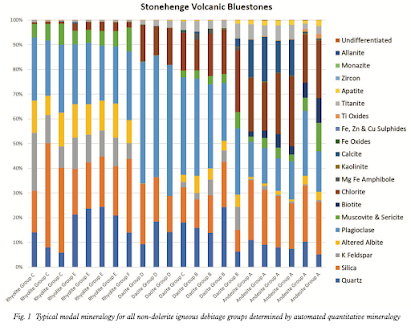
From article (1).  Twenty-two groups of non-dolerite Stonehenge igneous debitage (or is it seven? or maybe eight?  or maybe thirty or more?)

Two new papers have kindly been brought to my notice -- each written by Bevins and Ixer together with assorted geological colleagues.  They don't currently seem to be behind paywalls, but I have copies which I can supply as Email attachments on request.

Here are the details:

(1)  Treasures in the Attic: Testing Cunnington’s assertion that Stone 32c is the ‘type’ sample for Andesite Group A
by Rob A. Ixer, Richard E. Bevins, Duncan Pirrie and Matthew Power.
Wilts Archaeol & Nat Hist Magazine, vol. 116 (2023), pp. 1–15

Abstract

In 1881 William Cunnington excavated and sampled buried Stone 32c from within the Stonehenge Circle and described it as a ‘calcareous chloritic tuff’. He suggested that it was the source (type material) for similar looking debitage within the Stonehenge Landscape. Last described fifty years ago his original thin sections have been rediscovered and their investigation has shown that it was a reasonable conclusion based on his limited sampling. However, twenty first century investigations of thousands of pieces of this debitage, now defined as Andesite Group A (formerly Volcanic Group A), show it to possibly comprise two sub-groups, one being calcite-rich and the other being calcite-poor. Thin sections from Stone 32c show many of the characteristics of the calcite-bearing sub-group, but fewer of the calcite-poor sub-group but, for the present, Stone 32c is assigned as the type material for all Andesite Group A. However, Stone 32c may be the sole parent to all Andesite Group A debitage or only its calcite-bearing sub-group or it may share parentage for some or all of Andesite Group A with at least four other, as yet unsampled, stones (33e, 33f, 40c and 41d) buried within the Stonehenge Circle. Further research will answer these questions.

========================= 

(2)  The Stonehenge Altar Stone was probably not sourced from the Old Red Sandstone of the Anglo-Welsh Basin: Time to broaden our geographic and stratigraphic horizons?

by Richard E. Bevins, Nick J.G. Pearce, Rob A. Ixer,  Duncan Pirrie, Sergio Ando, Stephen Hillier, Peter Turner, Matthew Power. 
Journal of Archaeological Science: Reports 51 (2023) 104215

Abstract
Stone 80, the recumbent Altar Stone, is the largest of the Stonehenge foreign “bluestones”, mainly igneous rocks forming the inner Stonehenge circle. The Altar Stone’s anomalous lithology, a sandstone of continental origin, led to the previous suggestion of a provenance from the Old Red Sandstone (ORS) of west Wales, close to where the majority of the bluestones have been sourced (viz. the Mynydd Preseli area in west Wales) some 225 km west of Stonehenge. Building upon earlier investigations we have examined new samples from the Old Red Sandstone (ORS) within the Anglo-Welsh Basin (covering south Wales, the Welsh Borderland, the West Midlands and Somerset) using traditional optical petrography but additionally portable XRF, automated SEM-EDS and Raman Spectroscopic techniques. One of the key characteristics of the Altar Stone is its unusually high Ba content (all except one of 106 analyses have Ba > 1025 ppm), reflecting high modal baryte. Of the 58 ORS samples analysed to date from the Anglo-Welsh Basin, only four show analyses where Ba exceeds 1000 ppm, similar to the lower range of the Altar Stone composition. However, because of their contrasting mineralogies, combined with data collected from new automated SEM-EDS and Raman Spectroscopic analyses these four samples must be dis- counted as being from the source of the Altar Stone. It now seems ever more likely that the Altar Stone was not derived from the ORS of the Anglo-Welsh Basin, and therefore it is time to broaden our horizons, both geographically and stratigraphically into northern Britain and also to consider continental sandstones of a younger age. There is no doubt that considering the Altar Stone as a ‘bluestone’ has influenced thinking regarding the long-held view to a source in Wales. We therefore propose that the Altar Stone should be ‘de- classified’ as a bluestone, breaking a link to the essentially Mynydd Preseli-derived bluestones.

==========================

The first of these papers is yet another in the "dusty box" category, in which the geologists have discovered yet more "lost" or "forgotten" thin sections or rock samples which they now assign to one or another of their rock categories, which keep on being redefined at such a pace that those of us who try to keep up have long since given up in despair........  It's an exercise which no doubt keeps them amused, but one wonders how much use it actually is to anybody else. (Ixer, Bevins and co are not unique in this regard -- in glacial geomorphology there are also individuals and teams who delight in endlessly re-defining lithostratigraphic units, moving some upwards, others downwards, and others sideways, to the utter confusion of other specialists who prefer to get out and do some fieldwork.......)

The article contains some perfectly respectable analytical work, but reminds us that the bluestone assemblage at Stonehenge is so varied that classification schemes are essentially useless in our attempts to find out what happened on the site.  Over and again Ixer, Bevins and their colleagues have re-defined their major categories (for example Volcanic Group A which is now called Andesite Group A) and have had to admit that while some of their samples fall neatly within it, and maybe come from a single source area, others do not.   One of their diagrams seems to show 22 different rock types in the non-dolerite igneous groups, but they cannot tell us whether these have come from 22 different locations (or a smaller number) in the West Wales landscape.  There is nothing in this paper that contradicts my assertion that there are at least 46 different rock types in the bluestone assemblage, and that the sheer variety of lithologies and origins mitigates against bluestone quarrying, conscious stone collection and human stone haulage.

The conclusion of the paper is that "Andesite Group A comprises calcite-rich (including Stone 32c and possibly Stone 40c) and calcite–poor sub-groups. It may be that the calcite- poor sub-group should be reclassified into a separate lithic group(s) Andesite Group B, C etc that exclude Stone 32c (and possibly Stone 40c) as parents."  That's not going to make a headline in the Daily Mail or the Sun newspapers.........
When is a group not a group but a sub-group?  Ah, that is the question.......

This brings me to the fundamental defect in this paper.  Everything is based on the unproven assertion that all of the fragments of andesite bluestone (and all of the other bluestone fragments in the Stonehenge landscape) have come from existing monoliths, stumps or standing stones that have been destroyed.  These are referred to as "the parents".  That is illogical and unscientific.  This paper, which completely ignores the possibility that many of the fragments in the landscape have come from destroyed glacial deposits or from weathered erratics that have nothing whatsoever with Stonehenge, is therefore biased and unreliable, and I am amazed that the Editor of WANHM accepted it for publication in its present form.  Every study done by the geologists seems to throw up rock types that are NOT represented in the monolith assemblage, and the geologists are so obsessed with their ruling hypothesis that they seem to spend much of their time in a haze of classification and re-classification, much to their own confusion.

In refusing to accept that a proportion of the thousands of flakes, fragments, pebbles and cobbles in the Stonehenge landscape might have been there before human beings arrived on the scene, the authors of this article simply demonstrate, yet again, that they are obsessed with the confirmation, at all costs, of their ruling hypothesis of monolith quarrying and stone haulage.

==========

The second paper is similarly obsessed with the human transport hypothesis, and the authors do not even have the good grace to mention the "glacial transport alternative."  Its publication has been accompanied by a press release and PR campaign typified by this wondrous effort from the Daily Mail:

"Stonehenge's Altar Stone did NOT come from Wales: Scientists debunk popular theory and claim the Neolithic slab may have been brought in from Orkney - over 682 miles away."

There is some mystery about what is going on at the moment, because Mike Pitts reported on this paper on Twitter (now called X) and then reported that it had been withdrawn because it contained errors.  All will no doubt be revealed in time.........

Anyway, for what it's worth this is possibly the most bizarre paper ever published by the Bevins / Ixer team, mixing science and speculation in a manner that out-does all their previous efforts.  As indicated in the abstract, they key assumption is that the bluestones have been "sourced" in the Mynydd Preseli area -- ie quarried or deliberately selected, picked up and carried off to Stonehenge.  Human transport of bluestone monoliths is simply assumed to have occurred, without any proper analysis of alternative explanations including the glacial transport theory.  This is unscientific, and it is even more unscientific to ignore the vast numbers of smaller bluestone (ie foreign) clasts in the Stonehenge landscape simply because they are inconvenient.  As mentioned above, every attempt to tie down  bluestone erratics to specific geographical source locations or lithological groups seems to lead to an admission that there are yet more samples that "do not fit".

So to the geological investigations. At the outset we see speculative statements dressed up as facts.  Craig Rhosyfelin has NOT definitively been identified as "the source of the main rhyolitic debitage at Stonehenge", and neither has Carn Goedog been identified as "the main source of the spotted dolerites."  These sources are possibilities at best, and the authors simply do not know enough about related rock outcrops and lithologies to allow them to claim definitive provenancing.  Quote:  "........the bluestones in fact represent one of the longest transport distances known from source to monument construction site anywhere in the world."  Excuse me -- "in fact" ??? Another example of  geologists so swept along by their own hubris that they do not know the difference between a fact and a theory. 

The detailed geological analyses (using a number of different techniques) are interesting and informative,  and there is persuasive evidence that Altar Stone samples or Xray readings are substantially different from the majority of studied samples from the ORS of South Wales and the Borders.  Special emphasis is given in the study to the high concentrations of baryte (average over 2750 ppm)  in Altar Stone samples or proxies, as against much lower values in the 58 samples analysed from the ORS outcrops in the Anglo-Welsh Basin.  Only four samples out of 58 ORS samples had barytes concentrations over 1000 ppm. (The highest reading from an ORS sample was 2665 ppm.)   Those four samples, from widely scattered locations, were carefully examined, and they were found to have lithological and geochemical characteristics that were markedly different from the Altar Stone samples.  On this basis the authors concluded that the Altar Stone was probably not derived from anywhere within the area portrayed in their Figure 1.


It has to be pointed out that that conclusion is wildly premature, since it is simply not well enough supported by the evidence base.  Only 58 ORS samples from the map area have been analysed, and there has been hardly any new fieldwork.  Altar Stone readings show Ba concentrations across a wide range, from below 1000 ppm to almost 6000 ppm, suggesting to me that BA may not be a very reliable indicator.  Outcrops from across thousands of square kilometres of "candidate territory" have simply not been sampled at all, and the database shows that there are vast variations in lithology and geochemistry within the areas of outcropping sandstones.  The problem is a common one -- too much speculation and not enough evidence.

Case not proved.

In the latter part of the paper, where the authors speculate on other parts of the UK from which the Altar Stone might have come, they use stream sediment Ba concentrations as an indicator of "candidate locations."  By their own admission Ba concentrations in stream sediments can also be related to the presence of igneous bedrock -- so this is essentially a worthless exercise which need not take up any more of our time.  If we are to take any other Ba readings seriously, they must come directly from candidate sandstone outcrops.

I am interested in the manner in which the press release that goes with this article encourages people to think that the new research shows the possibility of human stone transport over a distance of 682 miles.  From Orkney!! Oh dear oh dear.......

Finally there is a section containing speculation that the Altar Stone "arrived" at Stonehenge later than the other bluestones.  Quote:  Because of its size the Altar Stone would have looked at odds amongst a ring of smaller bluestones so a possibility, to explain its anomalous characteristics, is that it arrived at a different time and from a different source area to the bluestones. ‘De- classifying’ the Altar Stone as a bluestone frees up thinking regarding a potential source for the stone and has led us to consider that it is an appropriate time to broaden our horizons, both geographically and stratigraphically in our search for the source of the Altar Stone.   

Quote ".....we propose that the Altar Stone should no longer be included in the “bluestone” grouping of rocks essentially sourced from the Mynydd Preseli."

This is of course all nonsense. First of all, the geologists define the term "bluestone" so narrowly that it excludes all the inconvenient foreign clasts at Stonehenge, and now they want to define it even more narrowly so that it excludes anything that does not demonstrably come from Mynydd Preseli.  This is not the way to do science.  It's bad enough that the authors of this article completely ignore the possibility of glacial transport or other transport mechanisms, but we are now into the theatre of the absurd.

=====================

PS.  29.09.2023.  Sorry -- I was mistaken as to accessibility.  Neither of these articles is easy to get at.  "Treasures in the Attic" can be found if you hunt for it, here:
You can get a draft version as a download.

The Altar Stone paper is behind a paywall, and you can get at it if you are prepared to pay $25 for the privilege.  In such a fashion articles full of dodgy science are protected from effective scrutiny.