THE BOOK
Some of the ideas discussed in this blog are published in my new book called "The Stonehenge Bluestones" -- available by post and through good bookshops everywhere. Bad bookshops might not have it....
To order, click
HERE

Tuesday, 13 August 2024

The Flimston erratics


This is a lovely drone image by Gareth Davies, showing the situations of the glacial erratics in the churchyard.  See also:

https://brian-mountainman.blogspot.com/2023/05/the-flimston-erratic-cluster.html

Note that the erratics were not discovered here -- they were brought in from assorted locations in the neighbourhood with the intention that they should be used as grave headstones.

Stone circles and stone sources


Callanish (Calanais) stone circle -- part of a larger stone setting of stones all "gathered" from the immediate neighbourhood.

Over on Sarsen-org our old friend Tim Daw continues his futile campaign to demonstrate that the stones in stone circles have almost always been carefully selected and "fetched" from somewhere else, preferably involving quarrying. He publishes a list of twenty stone circles across the UK, and says: "I have started investigating the sources of their megaliths. For most there are just assumptions, but where there has been research it seems that the stones are very deliberately chosen and brought to the site."  

This statement is carefully calculated to mislead;  it is also hilarious, implying that where researchers have spoken of stones being used where found (ie in the vast majority of cases) they are just making assumptions, whereas when proper research is done, the stones can be shown to have been carefully chosen and carried to their final positions.

That is absurd, and Tim knows it. According to the evidence that he himself cites, the builders of stone circles always used stones more or less where found.  At Gors Fawr, for example, there is no evidence of spotted dolerites being "sourced" by the builders in the nearby Preseli Mountains; but the stones are clearly glacial erratics, just like hundreds of other boulders of spotted dolerite scattered about in the vicinity.


We may take it that Tim has indeed heard of glacial transport.  He does mention glacial erratics, but appears to have no interest whatsoever in checking on local ice direction records, and his default position always seems to be that our ancient ancestors just loved looking for rather ordinary stones and transporting them over great distances.  Nice idea.  Pity about the lack of evidence.

The Curse of Premature Publication


There's an interesting editorial in Nature journal about the need to introduce "thinking time" into the daily schedules of scientists who otherwise work frantically and frenetically, with their research endlessly disrupted by Emails, mobile phone calls, meetings and so forth.

https://www.nature.com/articles/d41586-024-02381-x

The article makes many good points, but it is preoccupied with the practicalities of work scheduling, psychological aspects etc, and devotes hardly any space to the quality of research and the curse of premature publication.  On this blog I have discussed, on many occasions, the pressures on academics to publish as frequently as possible, and to place quantity far ahead of quality on their lists of priorities.  The pressure isn't exerted just on the researchers at the coal face -- heads of departments, university press offices and even vice chancellors want their institutions to be up there at the top of the rankings, based increasingly not on the quality of teaching but on the weight of research output.

In my mind, there is no doubt at all that this obsession with rapid and frequent publication has driven the research efforts of MPP and his colleagues.  Over and again they have written mediocre papers in which suppositions and assertions have taken the place of hard evidence.  There are scores of them, written far too early and therefore incapable of withstanding proper scrutiny -- but nonetheless accompanied by extravagant claims and banner headlines in the media...........

https://brian-mountainman.blogspot.com/2016/08/are-archaeologists-especially-prone-to.html

What we are seeing at the moment is a wholesale retreat from many of the things claimed as "the truth" over the last decade.   The provenancing of the Stonehenge bluestones is not at all as accurate as Bevins, Ixer and others have claimed, and far from pointing to one or two "key locations" from which bluestone monoliths might have been extracted, the work has flagged up the fact that the bluestones and the fragments in the local landscape have come from at least 46 different locations.  The number is going up all the time, as research continues.  The geologists should have given themselves more thinking time, and they should have been more careful.  The more people examine the "bluestone quarrying" hypothesis, the more ludicrous it appears -- and fewer and fewer people are prepared to accept it as fact.  The "lost circle" at Waun Mawn, hyped so cynically and irresponsibly in that infamous BBC TV programme, is now dead and buried, and it is widely accepted -- even by MPP himself -- that it has nothing whatsoever to do with Stonehenge.

OK -- the perpetrators of the Stonehenge bluestone mythology will say that they are honest scientists collecting evidence, publishing their results, developing working hypotheses, testing them, and sometimes rejecting them.  Well yes, that may be a fine line to take, but it doesn't wash with me when the "honest scientists" concerned completely ignore inconvenient evidence and steadfastly refuse to cite inconvenient peer-reviewed research papers which draw conclusions different to their own.  That, within a research community, is rather a serious crime.


The foolishness of the "bluestone mythologisers" is apparent when one looks at the new video produced by Carol and Jacky and now viewed by 26,000 people.  

https://youtu.be/GoobiRgv50g?si=SiKoBHcpAzs6QQUv

In the comments list published on YouTube, hardly any commentators are supportive of the MPP line, and one contributor after another expresses despair or disappointment at the lack of hard evidence backing up his pronouncements.  What they are doing, using a different form of wards, is attacking what Barclay and Brophy referred to as "interpretative inflation".   Many members of the public may be gullible, but when it comes to the crunch most of them are not so stupid as to accept everything said to them by a soggy archaeologist on a bleak Pembrokeshire hillside.......

So -- more thinking time and less haste?  Yes please.

Tuesday, 6 August 2024

The Stonehenge Bluestone Debate - What do we really know in 2024?


Here is a fascinating new video made by Coral Jackz -- at last, something that takes a long, hard look at both sides of the bluestone transport debate.  It's over an hour long. But big congratulations to the team for putting it together and for doing some serious homework......

------------------

PS.  The video has attracted almost 9,000 views after just three days.  Does that mean it has gone viral?  Anyway, congrats to Jacky and Coral, who must feel really chuffed that all their hard work has not been in vain.......   The discussion on YouTube is also rather interesting -- the usual mix of well informed comment, prejudice, supportive remarks and weird and wild fantasy!!

PPS.  on 12 August 2024.  Views of the video are now up to 21,000.  That is an amazing figure which attests to the abiding interest in Stonehenge, and the power of personal recommendations.  Coral and Jacky must be both surprised and delighted!  So more power to their elbows.  From a personal point of view, this is very gratifying since 21,000 more people have now become acquainted with my work and have discovered that  Alice Roberts, MPP and the BBC are not uniquely in possession of the truth.  Virtually nobody in the comments list has a kind word to say about that appalling BBC TV programme.


Sunday, 4 August 2024

Erratic sporting activities


One of the lesser-known erratic sports is erratic perching, as practised on the island of Blidö in Sweden.  The current record is 21 pebbles, achieved last year in calm and sunny conditions.  This year I only achieved 20 pebbles, and sustained a minor erratic injury when one of my more ambitious installations collapsed and left me with a seriously bruised foot.  It's a tough life being an erratic artist........ but the suffering is all in a good cause......

Saturday, 13 July 2024

Economy of effort in Neolithic Portugal


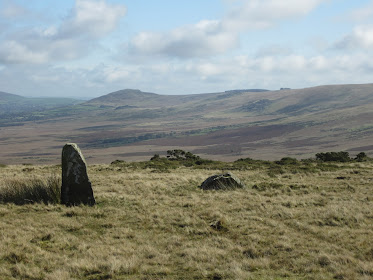
Xerex menhir (c 4m high) and stone setting

Middle States Geographer, 1999, 32: 110- 124

A GEOMORPHOLOGY OF MEGALITHS: NEOLITHIC LANDSCAPES IN THE ALTO ALENTEJO, PORTUGAL

Gregory A. Pope and Vera C. Miranda


Many thanks to Greg Pope for drawing my attention to this influential paper from 25 years ago, which had escaped my attention.  It reports on a fascinating piece of work which demonstrates that in the Portuguese megalithic monuments in this area of grantic rocks, the rocks used were almost entirely local -- used more or less where found.  Schmidt Hammer investigations revealed that there were no major differences in weathering characteristics between "used" megaliths and slabs and corestones which were lying about in the landscape.  Used stones and naturally occurring stones near rock ourcrops showed similar weathering characteristics, lichen cover and "buried" and "exposed" surfaces.  There was no reason to believe that any of the "used" stones had been quarried or transported across great distances.

This is exactly the point I have been making for years regarding the stones at Craig Rhosyfelin, Carn Goedog and Waun Mawn -- and indeed at Stonehenge.  The stones do NOT show any signs of quarrying or long distance transport -- and indeed if they are examined (as I have done with the Newall Boulder and the infamous big slab at Rhosyfelin) we can see weathered and unweathered faces and signs of different exposure ages, related to orientation or positioning in or on the ground surface.  When cosmogenic exposure ages are worked out for all these rock and boulder faces (as they will be) this quarrying fantasy will be thrown out once and for all........

To their credit, Ixer, Bevins and Pearce have already started to make measurements on dolerite and other rock surfaces in order to assess what geochemical changes are down to weathering processes; this is really interesting work, and I look forward to seeing the results when they are all drawn together. As far as I can see, none of the work so far has allowed them to differentiate between a "quarried" monolith and a naturally occurring one transported by ice!

The other relevant point here is the claim by MPP and others that the stone transporting expeditions which they love so much were done not because they were easy, but because they were difficult.  I have argued (as have many others) that the builders of Stonehenge were sensible enough to preferentially use stones found locally, as did the builders of all the other megalithic structures in Britain.  To have carried 80 megaliths all the way from West Wales would have been stupid, I reckon.  No no, say MPP and his friends, it would have neen stupendous, and highly sophisticated.  Well, if Portugal is anything to go by, the old residents of Alto Alentejo knew a bit about cost-benefit analysis and economy of effort.....

==================

ABSTRACT: 

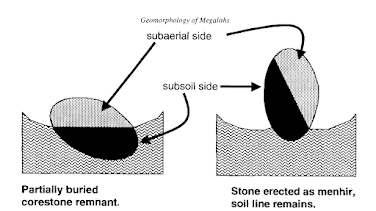
The Alentejo region of Portugal is known for a high concentration of Neolithic-aged megalithic monuments: tombs (dolmens or antas) and ceremonial features such as standing stones (menhirs) and stone circles (cromleques). Concentrations of these monuments tend to be found on or near weathered granite terrains.  Unloading slabs and remnant corestones appear to be the stones ofpreference for megalith makers in the Alentejo district of Portugal. Some of the stones may have been imported from distant sources, but most appear to be of local origin. In general, most stones do not appear to have been altered much from their original state as field stones. Weathering tests demonstrate that menhirs are essentially identical to native corestones.  Many menhirs still exhibit a soil line. The former subaerial side of the stone usually retains a thick growth of lichen, while the soil side remains oxidized. Newly exposed antas and menhirs now suffer from enhanced weathering and erosion from atmospheric and biological agents. This deterioration is often difficult to discern from the inherited decomposition of pre-megalithic time.


CONCLUSIONS

The granitic megalith stones of the Alto Alentejo are interesting for what they reveal about weathering rates. From this information, we can speculate about their origin and construction, and recommend practices for their conservation. The exposures results are summarized below. 

1) Naturally weathered outcrops provided material for these early megalith monuments, a practice possibly used in megalith construction across western Europe. Lack of damage to superficial weathering features suggests that megalith stones were not transported long distances, or alternately, were transported with great care.

2) Weathering processes active on the megaliths included biotic, mechanical, and microclimate-intluenced dissolution processes.  While there is evidence of some human alteration (in the form of engravings or dressing) that removes original surfaces, most megaliths in the Alentejo region have superficial weathering features similar to the local field stones. Schmidt hammer data on rock hardness corroborate these results. Except where altered, megalith stones are statistically identical in weathering-controlled rock hardness to natural field stones. Stone dressing and polishing remain relatively clear, and engravings, while muted, are visible after more than 5000 years of exposure.

3) Visually, megalith stones still retain former subaerial and buried sides, despite their current placement. Lichens grow on surfaces formerly situated on the subaerial side of the stone, while oxidation staining prevails on the former buried side of the stone. Areas with lichen are more weathered, with softer rock. Lichen colonization is an obvious concern for conservators, but eradication can be a problem if doing so damages the stone surface and any engravings. Where lichens are not present, there is no difference in weathering (as detected through rock hardness) between former subaerial and former buried sides, counter to what might be expected (and what appears on recently unearthed non-megalith field stones).

4) Post-emplacement exposure may be a factor in the degree of weathering. There is a preference for softer rock in a quadrant from southwest to northwest, independent of the presence of lichens or former subaerial or buried characteristics. This exposure factor cannot have existed prior to megalith construction, and suggests that post-megalith weathering overrides characteristics inherited over a much longer premegalith weathering interval. Conservators can anticipate areas of concern on certain exposures, particularly after ruined monuments have been excavated and reconstructed.

As "the first public monuments of humankind" (M. Gomes, 1997a), megaliths provide unique opportunities to extend geomorphic theory and conservation practice. Both geomorphic and built, megaliths exist at an age that promotes translation between studies of more recent building stone and more ancient natural landscapes. Further investigations in different climates (e.g. Brittany and Cornwall or Malta) and with different types of stone (sandstone, slate, etc.) can expand on the results presented in this initial investigation.

My three 2024 published papers


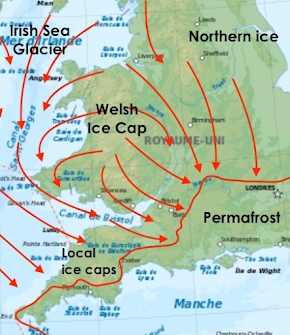
Postulated ice flow and erratic transport routes in one or more of the 
pre-Devensian glacial episodes


These are the three papers published so far in 2024. All of them have been received very well by the specialist group of researchers whose opinions I respect.........

Refs:


1. John, B.S. 2024. The Stonehenge bluestones did not come from Waun Mawn in West Wales. The Holocene, 20 March 2024 (published online), 13 pp.

https://www.researchgate.net/publication/379121966_The_Stonehenge_bluestones_did_not_come_from_Waun_Mawn_in_West_Wales

2. John, B. S. 2024. A bluestone boulder at Stonehenge: implications for the glacial transport theory. E&G Quaternary Sci. Journal 73, 5 June 2024, pp 117–134,

https://www.researchgate.net/publication/381205542_A_bluestone_boulder_at_Stonehenge_implications_for_the_glacial_transport_theory

3. John, B.S. 2024. An Igneous Erratic at Limeslade, Gower & the Glaciation of the Bristol Channel. Quaternary Newsletter 162, 28 June 2024, pp 4 - 14.

https://www.researchgate.net/publication/381775577_Quaternary_Newsletter_Article_AN_IGNEOUS_ERRATIC_AT_LIMESLADE_GOWER_AND_THE_GLACIATION_OF_THE_BRISTOL_CHANNEL

These three articles, published in quality peer-reviewed publications for an international readership, have had good media coverage and abundant hits, especially on Researchgate. The Waun Mawn article, which was published in March, has had more than 2,800 hits already, in addition to the 7,000 hits on the pre-publication version. The members of the "archaeology establishment" are undoubtedly reading my articles published over the last decade, even though those who are responsible for the promotion of the human transport myth refuse to cite anything written by me, since my ideas are far too disruptive. That's rather sad, and also rather pathetic, involving a betrayal of the ancient academic tradition that you must cite and deal with your opponents. So I am portrayed (behind the scenes) as a maverick and an incompetent old fool, drawing conclusions which are unworthy of consideration by those who like to think of themselves as "experts". It's a strange old world......

Alongside the thunderous silence of the Bluestone transport gang, we have the thunderous blogging of one Timothy Daw, who presumably thinks of himself as an expert because he shared the authorship of a "learned article" some months ago with Messrs Ixer, Bevins, Pearce and Scourse. Tim posts a stream of articles in which he seeks to rubbish my ideas and quesstion my competence, while demonstrating over and again that he knows nothing of glaciology or glacial geomorphology and has no particular wish to learn. Of course, he refuses to allow comments on his blog, so all of his preposterous claims about bluestones and earth surface processes, and about my hard evidence, go completely unchallenged. It's a strange old world..........

But there is no point in getting too upset about all this palaver, and I continue to be reassured by messages such as the following:
    
Quotes:

I have been sent a link to your paper. Thank you. It is a wonderful deconstruction of much of the hyperbole that surrounds SH.

........so good to see these arguments in print Brian!

Enjoyed the paper, but to be honest found it a bit ridiculous that it had to be written. There is clearly a problem in archaeology at the moment, it should not be possible to publish these nonsense papers.

Thank you so much for sending me your article. Such impressive scholarship and a cracking good read. Really questions the current narrative in a persuasive way. 

...........good media cover. extremely welcome!

.......very many thanks for the article. Congratulations once more -- great stuff.

..........thanks! it was great to see your previous article get a lot of attention in the media online, look forward to reading the new one

Well done, Brian. Good to get this published. Pity that a 100% provenance match was not yet possible.. Nevertheless, an important record. Enjoyed reading it.

Interesting article indeed and I think the gentle tone provides a convincing case for a discovery that bolsters your overall case....

Amazing what a lot of information can be derived from a piece of rock!

I believe you, for what that is worth! A wonderfully researched and presented paper. Congratulations!

Interesting read!

Thanks for this Brian. You are very restrained on the antics of the MPP myth factory.

Brilliant Brian.

Thanks Brian, great paper.

Good stuff - many thanks for the pdf. You are on roll!

I felt privileged to have an early sight of your latest 'offering'. I can see that you have put a lot of effort into producing it. Keep up the good work!

Excellent! I am a firm believer in the glacial theory of course. Seems obvious to me, and supported by evidence........

Your paper provides a compelling and thorough presentation.