THE BOOK
Some of the ideas discussed in this blog are published in my new book called "The Stonehenge Bluestones" -- available by post and through good bookshops everywhere. Bad bookshops might not have it....
To order, click
HERE

Wednesday, 4 January 2023

Cerrig Marchogion


Cerrig Marchogion, right up on the Preseli ridge, is not an easy place to photograph, but this splendid photo published by Hugh Thomas on the "Preseli 360" Facebook site, captures the character of the landscape really well.

You may recall that this site has been mooted, at various times, as a quarrying site for both spotted and unspotted dolerites, but now seems to have dropped out of the calculations.  If anybody thinks they have found a quarry up there, he / she must have a very vivid imagination.....

If you must have the truth, these stones are of course the petrified remains of the fallen knights of King Arthur, slain in battle against the fearsome giant black boar called Twrch Trwyth, back in the Bad Old Days.

Monday, 2 January 2023

The Limeslade "giant erratic" -- and another glorious myth


The blogosphere is a funny place -- filled with wonderful insights and complete crap.  If you are a blogger yourself, you rejoice in the former and have to tolerate the latter!!  Here is as fine a piece of nonsense as you are ever likely to see -- from Tim Daw's blog site called Sarsen.org:

https://www.sarsen.org/2023/01/6th-january-evidence-smoking-gun-or.html?lr=1

For some time Tim has gained great pleasure from slagging me off with regard to what he regards as a gigantic conspiracy.  He accuses me in his latest message of effectively covering up inconvenient research results concerning the "giant erratic" at Limeslade, near Mumbles, which was found by Phil Holden in January 2021.

Quote:

A year is a long time in academic geology. Looking back on it, it's actually quite intriguing to see how this piece of academic intrigue was instigated by somebody with an unshakeable belief that one theory (relating to human transport) was dead and buried, and that the only other theory in town (namely the bluestone glacial transport theory) must therefore be correct. He believed that all he had to do was find the evidence.

Quote:

Hailed by Dr Brian John as the 'greatest glacial discovery this century'...............

Well, I have never claimed this as "the greatest glacial discovery of the century".  I may be enthusiastic, but I am not that stupid,  and I have asked Tim to withdraw that remark.

If Tim had bothered to ask me, I would have been very happy indeed to put him in the picture, as follows:

1.  I am completely unconcerned about where the erratic might have come from.  Scotland?  Ireland?  North Pembrokeshire? Mid Wales?  Who cares?    Whatever its provenance might be, this is an important find.

2.  The samples are not mine.  They are Phil Holden's.  When we started discussing how they might be analysed, a professional geologist offered to prepare a thin section from one of them and to subject the other to pXRF analysis.  Dr Katie Preece at Swansea University offered to look at the results when they came through.  We were grateful for those offers, and accepted them.

3.  For a variety of personal and professional reasons, the geologist has not yet analysed the samples, in spite of frequent reminders and requests from us.  This is, as our readers will realise, a rather disappointing and embarrassing situation.........

4.  We have received recent assurances that the work will be done in the near future, and readers may rest assured that just as soon as we have the results they will be published, whatever they may tell us.

So just relax, Tim and everybody else.  There is no intrigue, and no conspiracy.

===============

PS.   I am happy to report that Tim has removed that remark from his blog post.  He has also, as far as I can see, done a considerable re-write, getting into something of a tangle over who said what, and when.  It all gets rather sterile and silly -- but for the record, I stand by my comment that Phil's discovery was "one of the most important chance discoveries of recent times" -- that is, in the field of Stonehenge bluestone research.  Chance discoveries like this are very rare, and are worth celebrating -- but they are clearly at the fun end of the spectrum as compared with discoveries made in the course of meticulous scientific research!!

Saturday, 31 December 2022

Glacial processes and landforms -- a big new paper

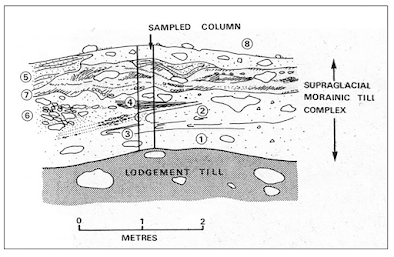
One of the illustrations from the new Report, showing lodgement till covered by extremely complex glacial and glaciofluvial deposits, mixed up and interbedded by the pattern and sequence of dead ice wastage and sediment remobilisation.  

This is a huge new report summarising the developments in glacial geomorphology over the past decades.  It's written by Dave Evans and Ian Evans from the Durham University Geography Department -- where I was once based.  It covers a vast range or territory, with copious references and illustrations.

I won't even attempt to cover the contents, but one thing stands out for me -- and that is the complexity of glacial sediments and landforms associated with different styles of ice wastage. Here is one interesting quote:

Understanding the modification of debris concentrations in glacier ice during melt-out has been critical to predicting the landform and sedimentary products of supraglacial environments. The sedimentary signature, termed melt-out till by Boulton (1970b), was portrayed as a material that could contain a preservation of former englacial debris banding, confirmed by the benchmark study of Lawson (1979a, b, 1981) on stratified basal ice in the Matanuska Glacier, Alaska. From this emerged the notion that it could also accumulate as landforms in a pattern that was dictated by those debris bands. This was encapsulated in the developing ideas on controlled moraines (cf. Gravenor and Kupsch 1959; see D.J.A. Evans 2009a for a discussion), defined more recently by Benn and Evans (1998) as supraglacially deposited hummocky moraine with a clear linearity related to inheritance of debris concentration patterns in the ice. 

Although Boulton (1970b) championed the concept of melt-out till, he nevertheless simultaneously emphasized (Boulton 1968, 1971) the fact that debris melting out on a glacier surface was invariably modified into flow till (sensu Hartshorn 1958). Indeed, a number of studies of supraglacial transverse moraines correctly identified their prominence prior to complete melt-out (e.g. Hooke 1970, 1973a, b; Holdsworth 1973; Fitzsimons 1990; Glasser et al. 1998; Hambrey et al. 1999; Ó Cofaigh et al. 1999; St Onge and McMartin 1999; Dyke and Savelle 2000), but none could unequivocally demonstrate a high preservation potential after deglaciation (see Dyke and Evans 2003; Lukas et al.2005; Evans 2009a for a critique). The theory behind this apparent dominance of reworking and lack of in situ, passive melt-out was expounded by Paul and Eyles (1990), who demonstrated that the process of thaw consolidation was capable of preserving englacial structure only if meltwater drainage away from the site was efficient; otherwise elevated porewater pressures decreased the frictional strength of the debris and increased the likelihood of failure and remobilization.

The Paul and Eyles (1990) study made it clear that supraglacial sediment remobilization is a ubiquitous process and that the ensuing shear instability and hydraulic instability that arise from excess porewater pressures will create a depositional setting in which controlled moraine preservation potential is extremely low. This is instead an environment where debris flow generation dominates. Working on such processes at the Matanuska Glacier, Alaska, Lawson (1979a, 1982) identified and subsequently classified a variety of gravity mass flow types.

I won't get into the complexities of all this, but there is one important point for our understanding of the Quaternary sediment sequences which we find in West Wales -- namely that wherever large masses of ice have melted away, we should expect re-mobilised or re-worked glacial, glaciofluvial and even periglacial deposits in abundance, and the most parsimonious explanation of this mish-mash of materials should always be that it is a direct product of ice wastage.  We do NOT need to assume that the materials in Pembrokeshire that have been variously referred to as "upper boulder clay" or "rubble drift" -- resting on top of Devensian till and meltwater deposits -- require a full glacial cycle in order to accumulate.  Maybe they just need a few decades of catastrophic ice wastage and sediment redistribution. 

Second, upstanding glacial features like morainic ridges and eskers do not necessarily represent places where there was "enhanced depositional activity".

Third,  we have to be very careful indeed about interpreting linear or upstanding depositional features as representing ice edge stillstands or even readvance phases.

This is relevant to all the debates that have gone on in the past on "remobilised till" or "ancient till redeposition" at places like Rotherslade, Morfa Bychan, Westdale -- with authors often invoking TWO glaciations by way of explanation. 


Redistributed stratified deposits at Westdale.  One glacial episode, or two?

Conclusion:  In West Wales we do not need to interpret any of the Quaternary sequences as representing two or more glaciations unless we can find hard evidence of interglacial sediments separating the materials dating from two separate glacial cycles, or else clear evidence arising from cosmogenic or other dating techniques.

=====================

https://www.lyellcollection.org/doi/full/10.1144/M58-2021-17
Glacial processes and landforms
Authors: David J. A. Evans  and Ian S. Evans
Publication: Geological Society, London, Memoirs 2022
Volume 58. 10 June 2022
pp 333 - 377
https://doi.org/10.1144/M58-2021-17


Abstract
From 1965 to 2000 glacial geomorphology became increasingly specialized and developed significantly due to technological improvements, particularly in remote sensing, surveying and field-based glaciological process studies. The better understanding of basal thermal regimes in ice sheets and glaciers led to the development of concepts such as spatial and temporal migration of ice divides in dynamic ice sheets that could overprint subglacial landform assemblages, debris entrainment processes related to polythermal glacier systems, and glacier and ice sheet beds composed of cold and warm based mosaics. Process observations at the ice–bed interface led to the discovery of the third glacier flow mechanism, substrate deformation, which provided the impetus to reconstruct the genesis of subglacial bedforms such as drumlins and to evaluate the origins and potential flow law for till. Numerical evaluations of glacial erosion led to a better understanding of abrasion and quarrying as well as the erection of genetic models and erosion rates for larger-scale features such as U-shaped valleys and cirques. Linkages were made between debris transport pathways and moraine construction in supraglacial environments, with the role of glacier structure being linked to specific landforms, such as medial, lateral, hummocky and ice-cored moraines as well as rock glaciers. Our appreciation of the erosional and depositional impacts of glacifluvial systems was enhanced significantly with the advent of process observations on the hydrology of modern glaciers as well as the final vindication of J.H. Bretz and his proposed jökulhlaup origins of the Channelled Scablands and the Missoula Floods. In addition to the increasing numbers of studies at modern glacier snouts, the embracing of sedimentology by glacial geomorphologists was to result in significant developments in understanding the process-form regimes of subglacial, marginal and proglacial landforms, particularly the recognition of landform continua and hybrids. Advances resulting from this included the recognition of different modes of moraine and glacitectonic thrust mass development, lithofacies models of the varied glacifluvial depositional environments, and the initial expansion of work on the sediments and depocentres of glacimarine settings, the latter being the result of glacial research taking to submersibles and ice-strengthened ships for the first time. A similarly new frontier was the expansion of research on the increasingly higher resolution images returning from Mars, where extraterrestrial glaciations were recognized based on comparisons with Earth analogues. Holistic appreciations of glaciation signatures using landform assemblages were developed, initially as process-form models and later as glacial landsystems, providing an ever-expanding set of templates for reconstructing palaeoglaciology in the wide variety of topographic and environmental settings, which also acknowledge spatial and temporal change in glacier and ice sheet systems.

Friday, 30 December 2022

Vertical wall features on Baffin Island


 Granite walls in Stewart Valley, eastern Baffin Island. Great Sail Peak.  We still do not fully understand why features as spectacular as these are created, and how they survive.......

Highway Glacier on Baffin Island, with spectacular downcutting in the upper reaches of the glacier.


Baffin Island again -- not sure of the location of this one.  But truly spectacular downcutting by the glacier, with vertical wall survival in a number of places.


Horseshoe moraine, Penny Ice Cap, Baffin Island


 This is a very unusual image -- from the NASA Ice Bridge Project.  It shows an unusual moraine formation flanking a little ice-free enclave on the plateau edge.  One small glacier tongue drops down to the steep slope to the left of the enclave, and another to the right -- what is unusual here is the smooth transition between the two.  

Monday, 26 December 2022

Good science and self-correction? Come off it.......


On the same day that I posted my piece about the bluestone confidence trick involving quarries and lost circles, along came an article on "Grid" -- an American web site which prides itself on looking at the science behind the news stories.
 
https://www.grid.news/story/global/2022/12/22/winter-solstice-is-coming-to-stonehenge-and-so-is-a-new-debate-over-the-ancient-monuments-mysterious-origins/

First of all, credit to Dan Vergano for covering this story and for reporting that the myth of the Lost Circle is now effectively dead and buried. He admits that there is a "new debate", apparently unaware that the debate has been going on for more than a decade. He also seems to think that the debate is being conducted within a small circle of "Stonehenge specialists" including MPP and the archaeologists in his team, geologists Rob Ixer and Richard Bevins, and Mike Pitts and Tim Darvill. It's actually being conducted across a much wider field, with key contributions coming from other geologists and glacial geomorphologists who specialise in the processes that affected the landscape of Britain during the Ice Age. That's one of the more unfortunate aspects of this new article -- a failure to recognise that geomorphologists and other scientists have skillsets which are of value in this debate and in many others.

So Dan does not question the quarrying hypothesis, and seems blissfully unaware that it was challenged in the peer-reviewed literature as long ago as 2015 and has been looking increasingly shaky every year since then.

On the matter of the Lost Circle hypothesis, Dan seems to think that the first doubts that were raised about it came from "a spate of new geochemical findings". Nothing could be further from the truth. The first doubts about it were raised by those of us who realised that the digs at Waun Mawn were throwing up such feeble evidence of a stone circle that there was really nothing to support the elaborate narrative being developed by Parker Pearson and his team.  We were pretty unimpressed by some of the claims being made by the geologists too.

Quote: "In true scholarly fashion, some of the researchers behind the Waun Mawn “Lost Circle” claim, including Parker Pearson, have now themselves found the chain of evidence that seems to put their own theory to rest."    In true scholarly fashion?  I wonder of the journalist who wrote this article has actually read any of the papers written by this particular research team?  If he had, I think he might agree that there never has been much scholarship involved in their project, which is based for the most part on very dodgy science and some dubious academic practices -- including a refusal to cite inconvenient evidence and a refusal to quote papers which dispute their field interpretations and their conclusions.

So the idea this this dispute is all very splendid, involving  skilled academics developing an hypothesis and then nobly self-correcting it, is really quite absurd.  If you look at the literature at the heart of the dispute about bluestone monolith quarrying and the "Lost Circle" you can come to only one conclusion -- that there was bad science and serious interpretative inflation from the very beginning, driven by hubris.  The whole miserable affair has done serious damage to archaeology in the UK, and to geology as well.

----------------------------

PS.  This is a worthwhile quote from Dan Vergano's article:

“On balance of probability, few, if any, of the stones from Waun Mawn ended up at Stonehenge,” concedes the “Debate” report from Parker Pearson and colleagues. It was a “delicate moment,” to come to that conclusion, said University College London geologist Rob Ixer, one of the authors of the new reports. The combination of geological and archaeological research that has uncovered Stonehenge’s quarries had taken decades, and required the application of much more high-tech geochemistry to Stone Age questions."

DV still seems to believe that the bluestone quarries existed, and that there has been much high-quality technical research that demonstrates their existence, but we will forgive him for that.  More to the point, this quote tells us just how difficult it must have been for MPP, Ixer and the rest of them to accept that for years they have been promoting a narrative that owes more to fantasy than to good science.


Friday, 23 December 2022

You have been conned: the papers that reveal the Waun Mawn scientific fraud


There have been so many twists and turns in the story of the bluestones over the past decade or so that it has been difficult to see the wood for the trees.  For the moment I will place to one side the multiple geological papers by Bevins and Ixer which would have been far more valuable had they stayed well clear of the archaeologists and their fantasies.  But  I have now tried to bring the following important articles together in one place with a view to clarifying the situation.


The Gospel according to Parker Pearson

These are the three papers that essentially make the case for Neolithic bluestone quarrying at Rhosyfelin and Carn Goedog and for the construction of a spectacular giant "lost circle" of standing bluestones at Waun Mawn.  They are so bad that they should never have been published -- and I am not the only one saying that.  They mix up speculation and evidence in a manner that is quite unacceptable academically.  There are many other articles from MPP and his team in popular journals, newspapers etc, and in book chapters, conference proceedings etc over the past decade.  If we ignore the occasional lapses into purple prose, they simply regurgitate the same material, but with even less regard for academic standards.  There are also assorted unpublished and published interim field reports which present evidence in a manner which is always heavy with confirmation bias and which can be dismissed from a scientific standpoint.  And we must not forget the infamous and heavily hyped BBC TV documentary called "Stonehenge: the Lost Circle revealed" which marked a new low point in BBC standards........

1. Parker Pearson, M. et al. 2015. Craig Rhos-y-felin: a Welsh bluestone megalith quarry for Stonehenge. Antiquity 89: 1331–52.
https://doi.org/10.15184/aqy.2015.177 (open access)

2. Parker Pearson, M. et al. 2019. Megalith quarries for Stonehenge's bluestones. Antiquity 93: 45–62.
https://doi.org/10.15184/aqy.2018.111 (open access)

3. Pearson, M. et al. 2021. The original Stonehenge? A dismantled stone circle in the Preseli Hills of west Wales. Antiquity 95(379), 85-103.
https://doi.org/10.15184/aqy.2020.239  (may be behind a paywall)

In those 3 papers you can see the evolution of the MPP team's increasingly convoluted narrative, as it tries to cope with inconvenient evidence (for example, radiocarbon age determinations) and tries to maintain the pretence that there is no dispute about anything.............  and readers who concentrate on the matter in hand will immediately notice that the team steadfastly refuses to cite any research by other authors which it considers to be inconvenient.

==========================================================================


John Downes, Brian John and Dyfed Elis-Gruffydd

The Sceptics, the Heretics and the Scientists

Then it all came crashing down.  These are the papers that document the collapse of the elaborate MPP theory involving bluestone quarries and a "lost bluestone circle".  These articles are also crucial in demonstrating serious scientific fraud:

Brian John, Dyfed Elis-Gruffydd and John Downes. 2015. "Quaternary Events at Craig Rhosyfelin, Pembrokeshire." Quaternary Newsletter, October 2015 (No 137), pp 16-32. https://www.researchgate.net/publication/ 283643851_QUATERNARY_EVENTS_AT_CRAIG_RHOSYFELIN_PEMBROKESHIRE https://www.academia.edu/19788792/Quaternary_Events_at_Craig_Rhosyfelin_Pembrokeshire

An examination of the geomorphology and sedimentology of the Rhosyfelin site, concluding that the features and the sediments are typical for Pembrokeshire, with a sequence representing a full Devensian glacial cycle dominated by glacial and rockfall (periglacial) processes, with no human interference.

===============================

John, B.S., Elis-Gruffydd, D. & Downes, J. 2015. Observations on the supposed “Neolithic Bluestone Quarry” at Craig Rhosyfelin, Pembrokeshire. Archaeology in Wales 54, pp 139-148. (December 2015)
https://www.researchgate.net/publication/ 286775899_OBSERVATIONS_ON_THE_SUPPOSED_NEOLITHIC_BLUESTONE_QUARRY_AT_CR AIG_RHOSYFELIN_PEMBROKESHIRE

An investigation of the supposed quarrying features at Rhosyfelin, and a critical analysis of the claims made by the Parker Pearson team.  Conclusion: the claims made about Neolithic bluestone quarrying are not supported by the evidence.

=========================

Brian John. 2018. The Stonehenge Bluestones. Greencroft Books, Newport. 256 pp. 
ISBN 97800905559-94-0
The author discusses the conflicting theories relating to the origin and transport of the bluestones.  He concludes that there is no evidence in support of the human transport hypothesis, but some useful evidence in support of glacial transport.  Most of the information in this book relates to geology and geomorphology.  On several occasions during the Quaternary Ice Age the Irish Sea Glacier flowed across Pembrokeshire, up the Bristol Channel and into Somerset. It carried with it glacial erratics from areas subjected to ice erosion. What is not currently known is the location of the ice edge further to the east.

========================= 

John, B.S. 2019. Carn Goedog and the question of the "bluestone megalith quarry”. Researchgate: working paper. April 2019, 25 pp.
https://doi.org/10.13140/RG.2.2.12677.81121
https://www.researchgate.net/publication/ 332739336_Carn_Goedog_and_the_question_of_the_bluestone_megalith_quarry

A careful and detailed assessment of the landforms and sediments at Carn Goedog, and an examination of the claims made by Parker Pearson and his team. Conclusion: there is no Neolithic bluestone quarry at this site. In any case, the five or six bluestones at Stonehenge now thought to have come from Carn Goedog are clearly NOT quarried elongated monoliths; they are simply weathered glacial erratics.

======================

Barclay, G. J., and Brophy, K. 2020. “‘A Veritable Chauvinism of Prehistory’: Nationalist Prehistories and the ‘British’ Late Neolithic Mythos.” Archaeological Journal 1–31.
https://doi.org/10.1080/00665983.2020.1769399

An analysis of the "over-interpretation" or "interpretative inflation" which are characteristic of much Stonehenge-related research. The authors are highly critical of the assumption made by some archaeologists that Stonehenge was the centre of everything, and they also criticise the selective sampling and interpretation that led Parker Pearson and others to propose that isotope evidence (from teeth and bones) pointed to a link between Stonehenge and West Wales. (I have also been highly critical of that on this blog.) The authors don't much like fanciful talk of Neolithic "political unification" either.......

=============================

Brian John. 2021. Waun Mawn and the search for “Proto-Stonehenge”. Researchgate: Greencroft Working Paper No 4, March 2021, 32 pp (updated September 2022)
https://www.researchgate.net/publication/345177590_Waun_Mawn_and_the_search_for_Proto-_Stonehenge

This extensive report examines the landscape and archaeological features of the Waun Mawn area in much greater detail than MPP and his team. With regard to the evidence from the field excavations, it is concluded that there might have been some small standing stones which were later removed or broken up, but there never was a small stone circle here, let alone a “giant” one. Furthermore, there have been no control studies in the neighbourhood which might demonstrate that the speculative feature has any unique characteristics. There is nothing at Waun Mawn to link this site in any way to Stonehenge, and it is concluded that the archaeologists have simply “discovered” what they wanted to find, and have created an elaborate and unnecessary bluestone narrative around it. No evidence has been brought forward in support of the claim that “this was one of the great religious and political centres of Neolithic Britain”.

============================

Brian John. 2021.  The Lost Circle at Waun Mawn: a commentary (updated).  Researchgate Preprint. 
February 2021
https://doi.org/10.13140/RG.2.2.31504.12802

This short commentary examines the 2021 Antiquity paper entitled "The original Stonehenge?" by MPP and his team.   Close scrutiny of the hard evidence presented (isolated from the speculations and assumptions) confirms that there was no "lost giant circle" at Waun Mawn, and shows that there is no geological or archaeological link between this site and Stonehenge. It is regrettable that so much time and energy has been expended on what was essentially a wild goose chase.

============================

Pearce, N.J.G.,  Richard E. Bevins, and Rob A. Ixer. 2022.  Portable XRF investigation of Stonehenge -- Stone 62 and potential source dolerite outcrops in the Mynydd Preseli, west Wales.   Journal of Archaeological Science: Reports 44 (2022) 103525.
https://www.researchgate.net/publication/361417309_Portable_XRF_investigation_of_Stonehenge_Stone_62_and_potential_source_dolerite_outcrops_in_the_Mynydd_Preseli_west_Wales

A geological examination of Stone 62 at Stonehenge and of possible links with Waun Mawn and the supposed "lost circle".  Conclusion:  Stone 62 probably came from eastern Preseli (Carn Ddu Fach) and had nothing to do with Waun Mawn.  So the excited matching of the stone to the socket was just a fantasy.

===========================

Bevins, R.E., Pearce, N.J.G., Parker Pearson, M., Ixer, R.A. 2022. Identification of the source of dolerites used at the Waun Mawn stone circle in the Mynydd Preseli, west Wales and implications for the proposed link with Stonehenge. Journal of Archaeological Science: Reports 45 (2022) 103556.
https://www.researchgate.net/publication/ 362119860_Identification_of_the_source_of_dolerites_used_at_the_Waun_Mawn_stone_circle_in_ the_Mynydd_Preseli_west_Wales_and_implications_for_the_proposed_link_with_Stonehenge

After a comprehensive study (which was clearly a waste of everybody's time) the authors failed to find any geological links between Waun Mawn and the so-called bluestone quarries, or any geological link between Waun Mawn and Stonehenge.    Having failed to sample the dolerite outcrops close to the Waun Mawn site, for reasons we will have to guess, the authors postulate that the stones may have come from Cerrig Lladron -- but the evidence for that is not convincing either.

=========================

Darvill, T. 2022. Mythical rings? Waun Mawn and Stonehenge Stage 1. Antiquity, 1-15. 

An analysis of the evidence presented by MPP and his team in support of the "lost circle" hypothesis.  Conclusion:  there was no circle and no intent to build a circle.  The stones present on the site may have been used in rather small and crude alignments.  The evidence for an "entrance" aligned with the summer solstice sunrise is poor. The so-called stone sockets are unconvincing.

===============================

Parker Pearson, et al. 2022. How Waun Mawn stone circle was designed and built, and when the Bluestones arrived at Stonehenge: A response to Darvill. Antiquity, 4 Nov, 2022. pp 1-8. https://www.cambridge.org/core/journals/antiquity/article/how-waun-mawn-stone-circle-was- designed-and-built-and-when-the-bluestones-arrived-at-stonehenge-a-response-to-darvill 

Here the authors defend themselves against Darvill's criticisms by citing evidence of a hearth and an oak tree at approximately the exact centre (yes, you read that correctly) of their putative stone circle that was never built. They reassert their view that the Aubrey Holes held bluestones and not posts.  They then reassert their claim that Waun Mawn was a place of significance in the Stonehenge story even though it had nothing at all to do with Stonehenge........ 

================================

Parker Pearson, M., Richard Bevins, Nick Pearce, Rob Ixer, Josh Pollard, Colin Richards, & Kate Welham. 2022. Reconstructing extraction techniques at Stonehenge’s bluestone megalith quarries in the Preseli hills of west Wales, Journal of Archaeological Science: Reports, Volume 46, 2022, 103697, https://doi.org/10.1016/j.jasrep.2022.103697

The authors claim that four small pieces of stone designated as "wedges" demonstrate how quarrying work was conducted at Rhosyfelin and Carn Goedog.  But not one of the "wedges" is in a fracture  that would have been useful for the extraction of bluestone monoliths.  Far from this being a site with a vast and elaborate "quarrying infrastructure" the authors now suggest that maybe one stone was taken from here to Stonehenge.  And far from Carn Goedog being used for "monolith extraction on an industrial scale", only five or six Stonehenge bluestones might have come from there -- and those are all weathered boulders, not elegant pillars.

================================

Parker Pearson, M. et al. 2022.  Interim Report for 2021 digging season. 

In this Report there is at last a recognition that there never was a complete stone circle at Waun Mawn, although there may have been an "intention" to build one. The authors still insist that there was a "partial" and rather crude circle here, and that some stones may have been taken away for further use at Stonehenge.

==========================


A decade is a long time in academic archaeology.  Looking back on it, it's actually quite intriguing to see how this piece of academic fraud was instigated by somebody with an unshakeable belief that one theory (namely the bluestone glacial transport theory) was dead and buried, and that the only other theory in town (relating to human transport) must therefore be correct.  He believed that all he had to do was find the evidence.  For some strange reason, he assumed from the outset that the bluestones could not have been simply collected up from the ground surface, but that they must have been quarried from significant places.  The geologists gave him some pointers, although their provenancing of bluestone rock types was far less precise than they would have us believe.  So all our heroic professor and his loyal team then had to do was  find the "quarries" -- and that is just what they claimed to have done, at Rhosyfelin and Carn Goedog, over several seasons of fieldwork.  Hype and hubris immediately took over, and the two papers in Antiquity magazine were published in the midst of massive media coverage.  

The members of the team knew from the outset that their evidence was completely inadequate to back up the extravagant claims being made -- but they refused to listen to the voices that urged caution, or to read the papers presenting inconvenient evidence, and the narrative became more and more exotic and fantastical.  When their own radiocarbon evidence falsified their own hypothesised timescale for quarrying, they simply made the narrative even more fanciful, by adding the "lost stone circle" component, thereby enabling the quarried bluestones to be parked somewhere convenient for 500 years or so, prior to transport to Stonehenge at the "right" time.  Again they refused to listen to anybody who urged caution, and the scale of media coverage became even greater, with the connivance of the editor of Antiquity, the BBC and multiple journalists.  There can be no doubt that all of those involved MUST have been aware that there was a dramatic mismatch between the quality of the evidence turned up in the digs, year after year, and the claims being made.  Was there self-delusion and self-deception?  Undoubtedly.  But the MPP team members were fully aware of the concerns of others who know their key excavation sites well, and refused to row back on any of their assertions.  So there was scientific fraud, year after year, with a massive and persistent over-interpretation of very thin evidence.  

And it was inevitable that the whole edifice would come crashing down, as it has.  

The claim that Neolithic always quarried their stone monoliths from special places?  As some of us have been pointing out for years, the more geological research that is done by geologists Robert Ixer and Richard Bevins, the more numerous the rock types incorporated in the bluestone assemblage.  The running total is now around 46 -- that in itself mitigates against any ideas of sacred stone types or quarries as "special places". 

The claim that there was a sophisticated quarrying infrastructure at Rhosyfelin and large-scale removal of orthostats?  Gone -- replaced by a feeble admission that maybe one small orthostat might have been removed.  After all, there is not a single standing stone at Stonehenge made of Rhosyfelin foliated rhyolite.   

The claim that Rhosyfelin is "the most perfectly preserved Neolithic quarry in Europe" and "the Pompeii of Neolithic stone quarries"?  Conveniently forgotten.  

The claim that there was bluestone monolith quarrying "on an industrial scale" at Carn Goedog?  Gone -- replaced by an admission that some smallish boulders at Stonehenge might have come from here or near here.    

The claim that quarrying and stone circle building were going on in Mynydd Preseli 500 years earlier than anywhere else in Neolithic Britain? Completely unsupported by any other archaeological work.  

The claim that Waun Mawn was at the heart of "one of the great religious and political centres of Neolithic Britain”?  Now conveniently abandoned.  The realisic interpretation of the Waun Mawn area is that it is interesting but unexceptional. 

The claim that Waun Mawn was the site of one of the largest stone circles ever discovered in Britain, dismantled and shipped off to Stonehenge?  Now replaced by the rather timid assertion that there may have been an uncompleted and partially dismantled circle here, which had no links with the "bluestone quarries" and no links with Stonehenge.  

And so it goes on.  One preposterous claim after another, unceremoniously dumped.  Now the research team wants us to believe that it was not the bluestones that were special, and not even the quarries, but the early stone circles -- of which there must have been several, still to be discovered.  It gets yet more bizarre. The team now suggests that maybe it was not the stone circles that were important, but the INTENTION to build them; and maybe it was not the transport of the bluestones that was important, but the sense of community and solidarity created by the INTENTION to move the stones.  And to make it even more bizarre, they suggest that because the bluestones at Stonehenge are a pretty mottley collection of bluestones of all shapes and sizes, and many different rock types, they must have come from an assortment of rather crude circles, demonstrating a preference for simplicity and unpretentiousness in contrast to the grandiose, sophisticated and powerful design ideal represented by the sarsen stone settings.  I kid you not.....

So when are the funding bodies, the academic institutions, the journal publishers, and the media going to admit that over the last decade of feverish digging and publishing activity, they have all been conned?