THE BOOK
Some of the ideas discussed in this blog are published in my new book called "The Stonehenge Bluestones" -- available by post and through good bookshops everywhere. Bad bookshops might not have it....
To order, click
HERE

Thursday, 10 November 2022

Waun Mawn and the so-called quarries -- the new papers


These references are scattered about a bit, so here they are all in one place.  You need to read the papers,  and not the abstracts or the press releases!!  Without any help from me, they demonstrate that there was no quarrying at Rhosyfelin, that there was no link between Waun Mawn and the two so-called quarries, and that there was no link between Waun Mawn and Stonehenge.   In other words, the whole narrative developed by Parker Pearson and his gang over the past decade can safely be ignored.

-------------------------------

Bevins, R.E., Pearce, N.J.G., Parker Pearson, M., Ixer, R.A., 2022. Identification of the source of dolerites used at the Waun Mawn stone circle in the Mynydd Preseli, west Wales and implications for the proposed link with Stonehenge. Journal of Archaeological Science: Reports 45 (2022) 103556.

Portable XRF investigation of Stonehenge -- Stone 62 and potential source dolerite outcrops in the Mynydd Preseli, west Wales. by Nick J.G. Pearce, Richard E. Bevins, and Rob A. Ixer. Journal of Archaeological Science: Reports 44 (2022) 103525.
https://www.sciencedirect.com/science/article/abs/pii/S2352409X22001882

Reconstructing extraction techniques at Stonehenge’s bluestone megalith quarries in the Preseli hills of west Wales,
Mike Parker Pearson, Richard Bevins, Nick Pearce, Rob Ixer, Josh Pollard, Colin Richards, Kate Welham
Journal of Archaeological Science: Reports, Volume 46, 2022, 103697,
https://doi.org/10.1016/j.jasrep.2022.103697

Darvill, T. (2022). Mythical rings? Waun Mawn and Stonehenge Stage 1. Antiquity, 1-15.
https://www.cambridge.org/core/journals/antiquity/article/mythical-rings-waun-mawn-and-stonehenge-stage-1/2F089B76AA2411BB09DBAFE79060101F

Parker Pearson, M., Pollard, J., Richards, C., Welham, K., Kinnaird, T., Srivastava, A., . . . Edinborough, K. (2022). How Waun Mawn stone circle was designed and built, and when the Bluestones arrived at Stonehenge: A response to Darvill. Antiquity, 4 Nov, 2022. pp 1-8.
https://www.cambridge.org/core/journals/antiquity/article/how-waun-mawn-stone-circle-was-designed-and-built-and-when-the-bluestones-arrived-at-stonehenge-a-response-to-darvill/5678888DF6FEE308A55BA0AA5BB41CF2#.Y2U-QMHffKg.twitter

Some of the authors of these papers haver claimed that this is all a perfect example of "science at work", with researchers correcting and refining their own working hypotheses. That's a bit rich, since their highly suspect work has been hotly disputed for the last decade or so in publications that could and should have been cited -- during which time they have NEVER admitted to any dispute.  That is tantamount to academic malpractice.

The BBC and the knowing perpetration of falsehoods


I have just had a phone call from a lady who informed me that the BBC recently (17 October)  broadcast -- for the sixth time -- that extraordinary programme called "Stonehenge -- the lost circle revealed."  Not only that, but the BBC itself is promoting the programme on its web site as one of the top science documentary programmes of 2021. 

Let's just remind ourselves that at the time of this latest broadcast, Alice Roberts, Mike Parker Pearson, the programme makers and the BBC all knew that the programme has been overtaken by events.  Not to beat about the bush, it was packed with assertions, speculations and falsehoods which have been challenged by me and various others on social media and (more to the point) revealed in two peer-reviewed publications in June of this year.  One of these showed that there is no geological link between Waun Mawn and the so-called bluestone quarries, and the other revealed that there is no link of any sort between Waun Mawn and Stonehenge.  In effect, the new publications demonstrated -- on the scientific record -- that the contents of the programme were nonsense.  In addition, a further paper then in the pipeline, with MPP as lead author, admitted that the scale of proposed quarrying at Rhosyfelin was minute -- if it happened at all.

There is no excuse.  The TV documentary should never have been broadcast in the first place, because it plays fast and loose with all of the norms of academic research -- but I suppose it could be counted as "entertainment" and justified by the makers on the grounds that those involved genuinely believed at the time that it was all honest and true. But with regard to the 17 October transmission, Alice Roberts and Mike Parker Pearson could and should have stopped it, since they knew at the time that the geologists had already exposed the Waun Mawn fantasies for what they are.  

And since a duty of care rests with the BBC as well, they should have stopped it without any prompting from anybody else.

A miserable episode from which nobody emerges with any glory.

===========================================

This is the blurb on the BBC web site:

In a world exclusive, Professor Alice Roberts follows a decade-long historical quest to reveal a hidden secret of the famous bluestones of Stonehenge.

Using cutting-edge research, a dedicated team of archaeologists led by Prof Mike Parker Pearson have painstakingly compiled the evidence to fill in a 400-year gap in our knowledge of the bluestones – and to show that the original stones of Britain’s most iconic monument had a previous life.

From the grand fantasy of medieval Merlin legends, to the chemical signatures in microscopic rock fragments, no stone is left unturned in the search for new evidence. By combining innovative 3D scanning techniques, traditional field archaeology and novel laboratory analysis, the team have discovered when and where the stones for Stonehenge were quarried and where they first stood.

Alice shows how the team discovered that the stones must have been quarried 400 years before they were first erected at Stonehenge. The team then focuses on trying to find out if the same stones had an earlier life.

Alice joins Mike as they put together the final pieces of the puzzle – not just revealing where the stones came from and how they were moved from Wales to England, but also solving one of the toughest challenges that archaeologists face.

Their revelations will rewrite the history of Stonehenge forever – this is the story of Stonehenge’s lost circle


How to confuse the opposition forces -- just make them dizzy


Before long, we will be back to a realisation that Rhosyfelin is just a pretty spot in the countryside, devoid of any archaeological significance whatever......


I have just noticed another extraordinary feature of the latest article about the Rhosyfelin stone wedges.  In a couple of places in the text the authors now seem to be suggesting that only one "pillar" was ever taken from here to Stonehenge, and that although they might have planned to take more, they seem to have changed their minds!  

That's in addition to the idea that the stone wedges supposedly knocked into the detached slab were not bashed in (ever so gently, with soft hammers)  with serious intent, but were just a sign of the locals practising in their spare moments,  in preparation for something more serious.  

So they now expect us to believe that the vast quarrying infrastructure full of engineering features that they claim to have discovered, in one article after another, was developed just for the extraction of ONE stone?

Initially, the stones from the so-called bluestone quarries were supposed to have been shipped off directly to Stonehenge, but then, when the radiocarbon dates didn't make any sense at all, the story was changed to allow the bluestone monoliths to be parked up somewhere else for a period of c 500 years.

The stones at Waun Mawn were said to have come from the bluestone quarries at Rhosyfelin and Carn Goedog, and when that was shown not to be in line with the local geology, they were deemed to have come from a quarry (as yet undiscovered) at Cerrig Lladron. Where next, I wonder?

Initially, the bluestones at Stonehenge were all supposed to have come from one or two quarries, but as the geological work has progressed, it has become increasingly clear that there are multiple stone provenances, some of them as yet unknown.  It's obvious that most of them have NOT come from quarries at all.

The dizzying speed of these hypothesis modifications is all too much to cope with.  In recent months we have already seen an admission from MPP that there never was a stone circle at Waun Mawn, followed by the proposal that they clearly INTENDED to build a circle, but never quite got round to it.  

Then we have an acceptance of the confirmation by the geologists that Waun Mawn has nothing to do with Stonehenge, followed by more ruminations that there must therefore be other "temporary" circles where desirable stones were parked up prior to shipment off to Salisbury Plain.  They must be out there, waiting to be found.   

In a couple of other rather obscure publications I have even seen MPP accepting that most of the bluestones at Stonehenge are not elegant pillars -- as I have been telling him for years --and then speculating that maybe the builders of the monument preferred distressed and abraded boulders anyway, which were fashionable at the time.......  Urban chic giving way to rural charm, maybe?

From the very beginning, too much narrative and too little evidence, as is perfectly clear to everybody watching the pantomime from a safe distance.

Now you'd better lie down in a darkened room for a few minutes, breathing deeply and thinking beautiful thoughts.

==================


Reconstructing extraction techniques at Stonehenge’s bluestone megalith quarries in the Preseli hills of west Wales,
Mike Parker Pearson, Richard Bevins, Nick Pearce, Rob Ixer, Josh Pollard, Colin Richards, Kate Welham
Journal of Archaeological Science: Reports, Volume 46, 2022, 103697,

https://doi.org/10.1016/j.jasrep.2022.103697

Prehistoric features of Waun Mawn, Tafarn y Bwlch and Banc Llwydlos


Now that Parker Pearson and his colleagues are at least beginning to acknowledge that there are many interesting prehistoric features (mostly Neolithic and Bronze Age) in the area of interest around Waun Mawn, here is a reminder of what we know, based largely on the work of Dyfed Archaeology personnel......

https://www.researchgate.net/publication/349119686_Waun_Mawn_Supplementary_Data

Wednesday, 9 November 2022

Imaginary wedges and useless lumps of rock


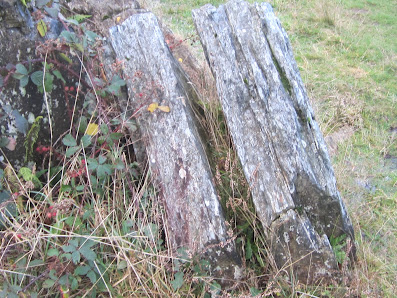
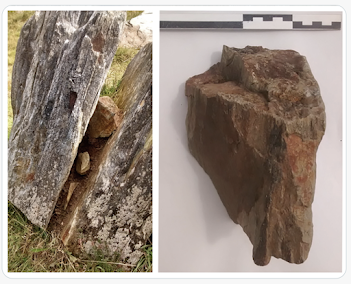
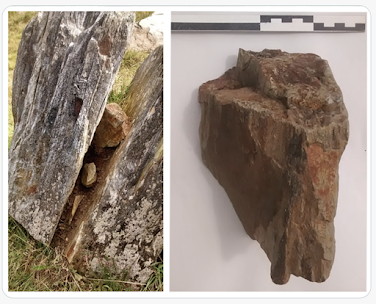
The small slab near the tip of the spur, split into two slices.  In the gap between the two, the geologists claim to have discovered two stone wedges and a hammerstone.  The complete slab was probably separated from the main rock outcrop long before any human occupation of this site.  Neither of these small slices would have been of any use as a standing stone.

It was very pleasant down at Rhosyfelin today, in between the showers.  More on the latest paper from the Rhosyfelin quarrymen.....

I have been taking a look at the places at Craig Rhosyfelin from which the "quarrying wedges" were taken for analysis by Richard Bevins and his colleagues.  You will recall that they were claimed by Parker Pearson et al to be wedges used to force cracks or crevices apart by percussion with "soft hammers" -- with the object of obtaining monoliths for use in stone settings.  But then they also claimed to have found at least one stone with percussion damage on it, which presumably means it was a hard hammer.  And why would one bother to use wedges, levers and hammers (either soft or hard) to extract large bits of rock from the rock face when there are scores of slabs, boulders and pillars of all shapes and sizes lying around in the rockfall debris, ready to be picked up and carted away?

There are several issues here.  I can't argue about the evidence on the so-called wedges, because they have been taken away -- except to say that I see no difference (in the photos) between them and a multitude of other bits and pieces found in cracks and fractures across the whole width of the rock cliff exposure.

1.  The crack locations.    

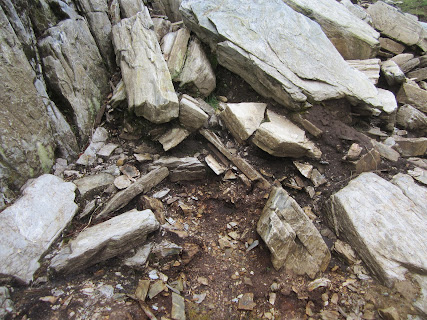
The crack from which stones 133, 134 and 135 were taken was filled with debris which was cleared away by the geologists.  This debris is simply referred to as "the same sediment as that formed around the Neolithic hearth."  That's not good enough.  There is a strong probability that the sediment was the same rockfall debris as that found in many other cracks in the vicinity, and that it had nothing whatsoever to do with the hearth. According to Fig 7 and Fig 9 in the article, stone wedges 136 and 137 (each broken into two parts) were found in cracks and contained in an assortment of rockfall debris and humus-rich soil quite typical of this site. One crack is parallel with the foliations, and one is transverse.  We don't know how much sediment has been removed and thrown away by the geologists. There is nothing exceptional about rockfall fragments being broken or splintered; that is what happens when rockfalls occur.


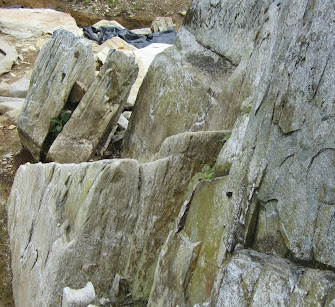
Top left in this photo taken during the dig:  the detached block, split in two, with the "stone wedges" visible.  It is NOT a bedrock outcrop.


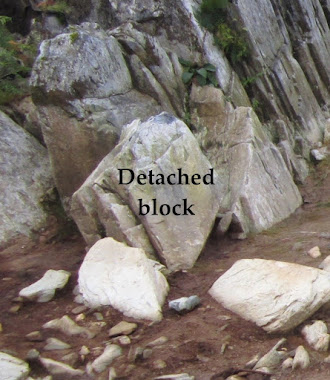
Another image of the detached block, with its bottom corner embedded in sediment.


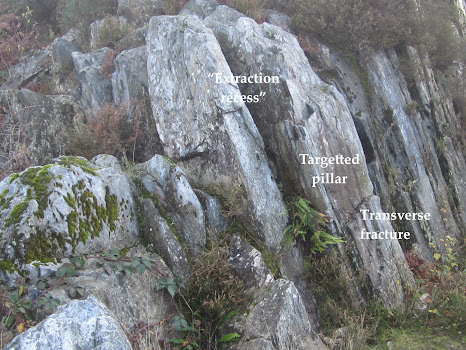
2.  The "pillars" that were supposedly targetted by the quarrymen.    

Actually one of them (adjacent to which wedges 134 and 135 and hammerstone 133 were found) is not a pillar at all, but a detached slab that has been split into two.  It is embedded in sediment, and probably fell off the crag many thousands of years ago.  The geologists involved in this article knew that this was a detached block rather than a bedrock outcrop, but they refer to it on p 4 as "a joint in the bedrock".  Then they refer to it as "a boulder."  Very confusing. There is no reason why it should have been considered a desirable piece of rock, since there are plenty of other smallish flat slabs littering the surface in the neighbourhood.  Its dimensions are about 1m x 1m x 30 cms -- of no value whatsoever if Neolithic quarrymen were looking for orthostats.


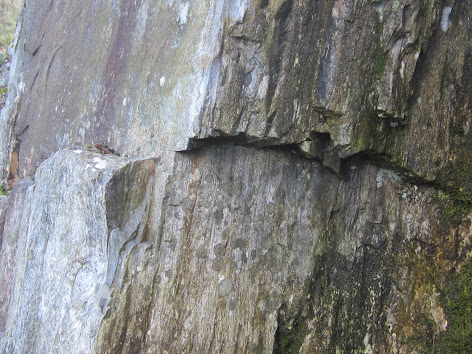
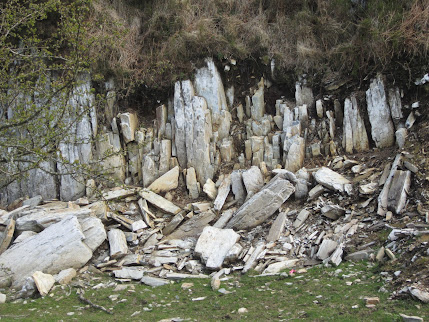
The massive "targetted pillar" -- estimated to have been at least 3m long and to have weighed close to 8 tonnes. If it had been levered away from the rock face, it would have broken into two.  The "extraction recess" is too shallow to have ever contained a bluestone pillar; but fracture scars show that a number of small blocks have broken away from here, probably in association with Quaternary erosional episodes.


  The transverse crack running across the massive pillar that the Neolithic quarrymen are assumed to have desired.  The pillar could never have been levered away from the rock face without 
breaking into two.

The crack adjacent to what MPP has referred to in the past as "the monolith extraction" point is even more problematical.  In it, wedge 137 was found, suggesting to the authors of the paper that a large pillar was deemed suitable for levering away from the parent rock, supplemented by another wedge (136) in a deep crack on the top of the ridge, in a position suitable for levering the putative pillar away from the face. They suggest that a pillar 2.6m x 1m x 60cms was the "target" -- but that the quarrymen gave up maybe because they failed to "set it free."  This makes no sense either.  Having examined this block, I can say that it is almost as big as the 8 tonne "picnic table" which has attracted so much attention at Rhosyfelin.  That's far bigger than anything used in standing stone settings in West Wales -- except for some cromlech capstones that were used more or less where they were found.  That stone could never have been levered away from the face without first dislodging a smaller "pillar" to the north of it, at the point referred to by Parker Pearson as the "stone extraction recess."  (That recess is, in any case, a product of a fertile imagination, because it is only about 20 cms deep, and because there is evidence that  several distinct blocks (as distinct from an elongated pillar) have fallen away from it during a number of quite widely spaced episodes.  The fracture scars associated with these episodes can still be seen.)  And there is a compounding problem in that this massive block of stone has a transverse or crossing fracture about 1.8 m from its top, which means that it could never have been levered from the rock face intact;  it would have broken into two, again rendering it useless for any planned stone setting.

Even if the bits of stone so grandly referred to as "stone wedges" were indeed used as hypothesised by the authors of this article, they would have been completely useless as standing stones.

The whole idea of quarrying at this site is preposterous, and no matter how many "learned papers" the geologists produce in support of it, they still have not come up with any hard evidence that makes any sense.  All of the features at this site are natural, and I suspect that conclusion is not going to change.

Tuesday, 8 November 2022

Bluestone wedges and the death of science


Thanks to various kind people,  I now have several copies of the new article about imaginary wedges, published in the Journal of Archaeological Science!   Not to put too fine a point on it, this is probably the least scientific paper I have ever read in a learned journal, and it is amazing that it has made its way through a refereeing and editing process and ended up as a publication.  On my first reading I thought it had to be a practical joke -- but now I suppose we have to take it seriously since others who know nothing of Rhosyfelin and Carn Goedog will simply assume that it is reliable......

The details again:

Reconstructing extraction techniques at Stonehenge’s bluestone megalith quarries in the Preseli hills of west Wales,
Mike Parker Pearson, Richard Bevins, Nick Pearce, Rob Ixer, Josh Pollard, Colin Richards, Kate Welham
Journal of Archaeological Science: Reports, Volume 46, 2022, 103697,

https://doi.org/10.1016/j.jasrep.2022.103697

In the very first paragraph the inherent bias of the authors is flagged up when they assume that most, if not all, megalithic monuments are linked with quarries.   How's this for a throwaway line?  "In the case of Stonehenge, the distance from quarry to eventual destination is the maximum known for megalithic monuments anywhere in the world (Parker Pearson et al., 2020a)."   That sets the scene for the whole article, and we know that everything that follows is going to be part of an exercise in quarry confirmation.

There follows an extended exercise in self-citation, relating to the nature of the bluestones and their possible provenances.  (Interestingly, the main "possible" and "probable" provenances examined in earlier publications have now become matters of fact in the eyes of the authors, although they do admit that many of the bluestone sources are still a matter of speculation.)   They fail to mention that there are at least 46 different rock types in the Stonehenge bluestone assemblage, and that this fact alone strongly mitigates against a dependence upon quarried stone sources.)

In the section on "megalith extraction" at Carn Goedog we find a summary of the evidence and speculations contained in the 2019 Antiquity paper -- so it's full of highly dubious statements about "quarrying" features and techniques, without any attempt to examine alternative explanations for the morphology of the rock faces or the sediments examined. And as in other papers dealing with Carn Goedog, there is a highly convoluted use of radiocarbon dates to enforce a desired chronology, while the authors conveniently ignore all the dates that are not convenient. I won't go through my detailed critique, because I have done it before, on this blog. But the authors could, and should, have cited my 2019  paper (on Researchgate) entitled "Carn Goedog and the question of the “bluestone megalith quarry” because it directly addresses many of the claims made about quarrying.

https://www.researchgate.net/publication/332739336_Carn_Goedog_and_the_question_of_the_bluestone_megalith_quarry

Then we get to the main part of the article, on Craig Rhosyfelin, and from here on in, it's all downhill. The authors do at least admit that there are no Rhosyfelin rhyolite monoliths at Stonehenge, but they make it clear from the outset that this is -- in their minds -- a Neolithic bluestone monolith quarry, even if they have no idea where the monoliths went and even though foliated rhyolite is anyway a lousy rock type for standing stones.  Again, much of the text here is simply a resume of the contents of multiple other papers by the same group of authors, and the text here is packed with speculations and assertions that are unsupported by hard evidence.  We have analysed the shortcomings of the presented evidence and questioned a whole host of dodgy conclusions on many occasions on this blog.  

But then we get to a much more serious problem.  This is supposed to be a serious scientific paper, and an obligation is placed on all authors of such publications to honestly cite sources and evidence that might not be convenient for the hypothesis under consideration.  Yet nowhere is there any mention of the two peer-reviewed papers published by Dyfed Elis-Gruffydd, John Downes and myself in 2015 -- and there is no consideration either of the points of interpretation which are disputed.  That is cowardly and disrespectful, and the editor of this Journal should not have allowed Parker Pearson and his fellow authors to get away with it.

As with Carn Goedog, the radiocarbon evidence (which many independent observers see as conclusively falsifying the quarrying hypothesis) is manipulated and selectively used to reinforce the desired timetable of events.


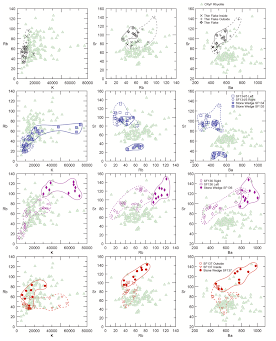
The bulk of the article deals with so-called "stone wedges" at the two so-called quarrying sites.  It all looks very scientific, since there are tables, bivariate plots, principal component analyses, annotated photos and so forth.  As usual, the authors cannot resist telling us what to believe instead of presenting us with evidence and letting us draw our own conclusions.  So they tell us that they have found three notable stone wedges when we simply see angular and flattish fragments of shale, mudstone and foliated rhyolite which are indistinguishable from thousands of others in their so-called "quarries".  They say they have evidence of splitting, scratching and percussion damage on the wedges, but that is not adequately demonstrated, and from my knowledge of both sites I can say that I have picked up scores of similar stone fragments with wedge shapes, scratches and surface damage from fissures, cracks, fractures, gaps and exposed sediment surfaces right throughout the excavated area.  From what we can see, there is nothing at all unusual or notable about the "stone wedges" numbered SF134, 135, 136 and 137 which are subjected to detailed analysis.  

A huge amount of work has been put into the pXRF work on the so-called wedges and their "host cracks", with the authors then claiming that the wedges were probably not derived from the walls of the cracks.  In the minds of the authors:  "geochemical analysis reveals that these and the third wedge are of compositions different to the rock on either side of the cracks into which they had been driven, confirming their identification as quarrying tools.


Plots of the Xray readings for the so-called wedges, set against the plots for multiple bedrock sites at Rhosyfelin.  What do they tell us? That the lumps of rock concerned did not necessarily come from the walls of the cracks they were found in.  But we knew that already.......


That is a wildly irresponsible assertion, bordering on scientific fraud, because the authors fail, anywhere in their text, to tell us that rockfall debris is the principal component of the rock face at Rhosyfelin and the inner part of the excavated area. Almost every crevice and fracture is filled with debris which has fallen from above or been forced in from the side during thousands of years of sediment accumulation. Many of the fragments in this debris are broken and scratched.  The authors pretend that "colluvium" is the sediment that might be expected to wrap around the wedges in cracks and crevices, but that is an absurd distortion of the truth.


Rockfall debris is the principal component of this site, with a constant supply of broken rock fragments and soil associated with the degradation of the crag. Additional debris has been brought into the dig site by glacial and fluvioglacial processes.  needless to say, many of the fragments are sharp-edged, wedge shaped, scratched and damaged by percussion events.


Quote:  "We are fortunate that Carn Goedog and Craig Rhos-y-felin have preserved good evidence in the form of stone tools as well as features such as artificial platforms, the recesses left by extracted monoliths and, especially, the cracks into which stone wedges were hammered."  One fantasy after another, relating to "worked stone assemblages", "soft-hammer percussion" and much else besides........

The final section of the paper, relating to other "quarrying sites" in Europe, may or may not be reliable.  I'll leave that for others to decide! But these are the last words:

"Wedges SF136 and SF137 were positioned so as to extract a pillar directly beside the recess from which we reckon a monolith was removed and taken to Stonehenge. This was quite possibly the buried stump Stone 32d within the Bluestone Circle. Just why that second pillar was never removed from the Craig Rhos-y-felin outcrop is unknown. Was it surplus to requirements? Was it too securely attached to be worth the effort of extraction? Or was it considered to be structurally unsound? Such questions may seem insignificant against the larger one of just why the bluestones were taken 240 km (170 miles) to Stonehenge but the close interrogation of quarrying methods and technology is a small step towards reconstructing the context of that extraordinary event."

I am lost in admiration.  It is not often that one encounters such fertile imaginations, or such vast amounts of effort devoted to finding out nothing of any interest.  So what a sad waste of time.   After all, there are no known foliated rhyolite monoliths at Stonehenge, and this material was hardly ever used in stone settings in Pembrokeshire either.  And why would our heroic Neolithic ancestors go to all this trouble of wedging, hammering and levering furiously in a highly inconvenient location when, if they wanted some nice stones, all they had to do was pick them up from the rockfall debris or from the surrounding landscape and carry them away?

========================


Monday, 7 November 2022

The quarries and the wedges -- here we go again


Rhosyfelin -- every fissure is packed with detritus.  Were some of the fragments put there and used as wedges in the process of quarrying?  Let's see the colour of the evidence.......


More fun and games:

Reconstructing extraction techniques at Stonehenge’s bluestone megalith quarries in the Preseli hills of west Wales,
Mike Parker Pearson, Richard Bevins, Nick Pearce, Rob Ixer, Josh Pollard, Colin Richards, Kate Welham
Journal of Archaeological Science: Reports, Volume 46, 2022, 103697,

ISSN 2352-409X,

https://doi.org/10.1016/j.jasrep.2022.103697

(https://www.sciencedirect.com/science/article/pii/S2352409X22003601)

ABSTRACT

Excavations at two of the sources of Stonehenge’s bluestones in Mynydd Preseli, west Wales, have led to the discovery of stone tools associated with megalith quarrying in the final centuries of the fourth millennium BC, shortly before the suspected date of the bluestones’ erection at Stonehenge, 240 km away. Among the most plentiful of these tools are stone wedges, three of which were found in situ at the rhyolite bluestone quarry of Craig Rhos-y-felin. Two of these were positioned in the joints of a rhyolite pillar adjacent to a recess left by a removed pillar. Geochemical analysis reveals that these and the third wedge are of compositions different to the rock on either side of the cracks into which they had been driven, confirming their identification as quarrying tools. This research sheds new light on the methods used to extract the stones for Stonehenge.

We have been here before, with reports of soft shale wedges in cracks and crevices at Carn Goedog and with mentions of "tools" at Rhosyfelin as well.  We have all seen abundant debris in cracks in the foliated rhyolite crag, derived from rockfall material and also from glacial and fluvioglacial deposits brought in to the site during the last glacial episode.  

But let's see the evidence before assessing the reliability of the claims being made.  Unfortunately the article is behind a paywall, so I have not been able to read it.  Perhaps somebody will be kind enough to send me a PDF........

One of the fissures near the tip of the spur at Rhosyfelin, and one of the so-called stone wedges.  
Courtesy Tim Daw and Twitter.


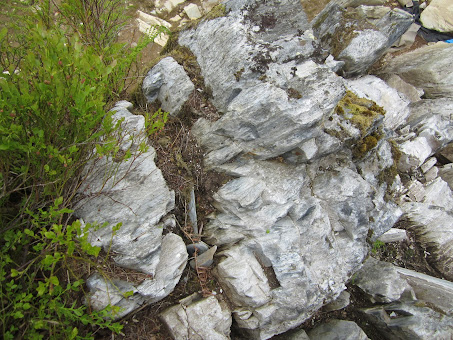
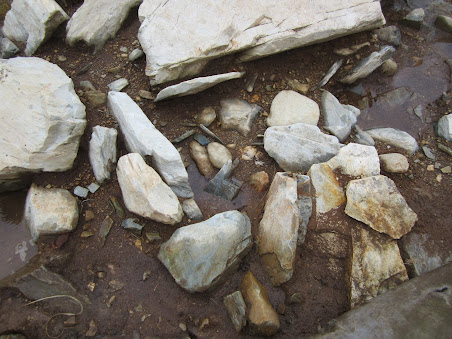
Glacially transported clasts and detached rhyolite blocks near the tip of the spur.  Note that some of the clasts are wedge-shaped........

==========================

PS.  We have had some previous discussion about wedges here: